
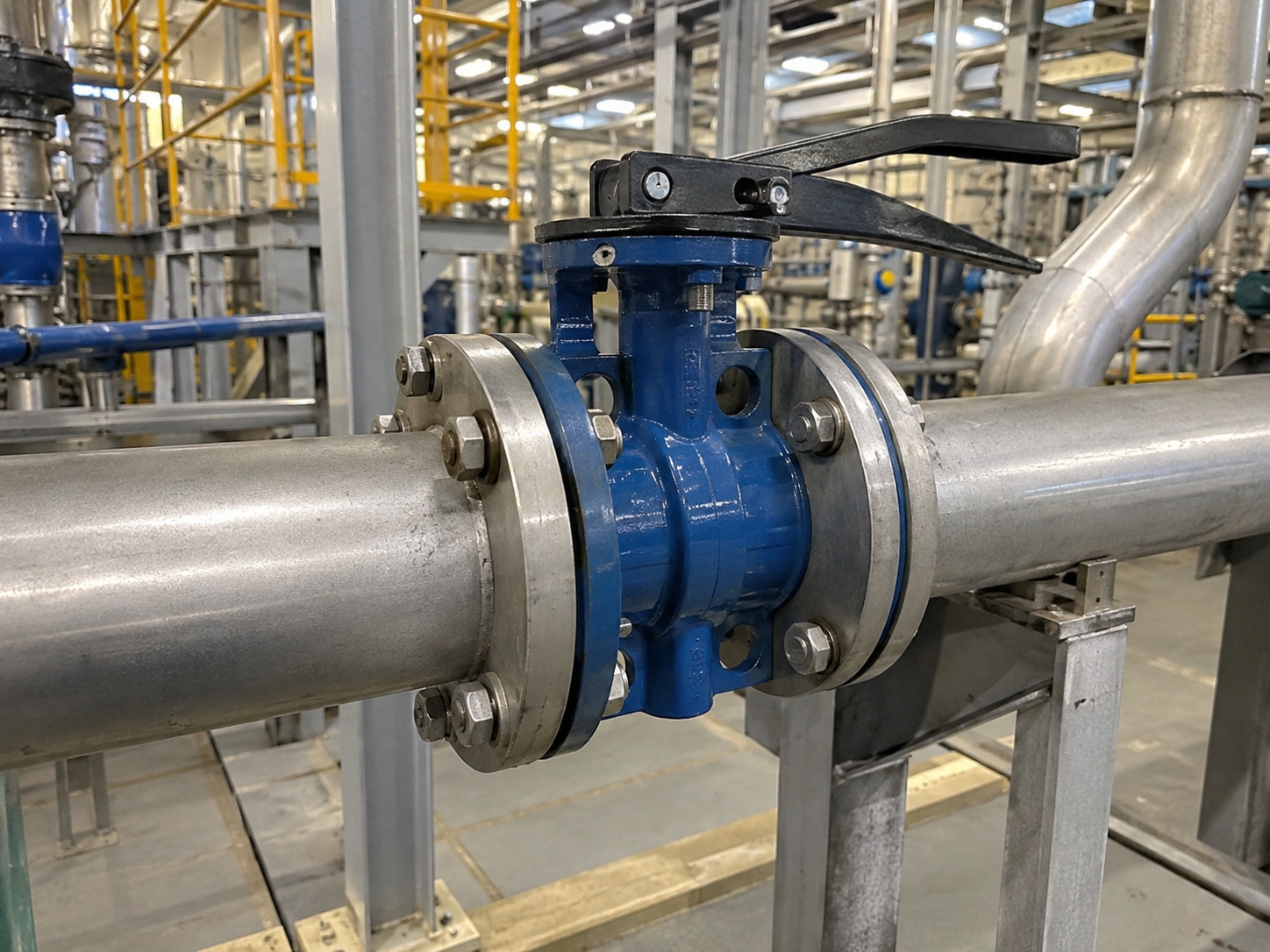
The butterfly valve characteristics that most affect performance are its quarter-turn disc motion, compact construction, high flow capacity, design-dependent shutoff, nonlinear throttling behavior, material limits, and torque response. They suit many large utility and process lines, but none is a universal advantage.
For example, the current RUITO industrial butterfly valve range spans DN25–DN3000 and PN10–PN25, with several body, disc, and seat materials. That breadth illustrates an important point: the name “butterfly valve” describes a mechanism, not one fixed performance envelope. You still have to match the valve design to the medium, temperature, differential pressure, required flow range, shutoff duty, connection, and actuator.
The Disc Mechanism Creates Both Benefits and Limits
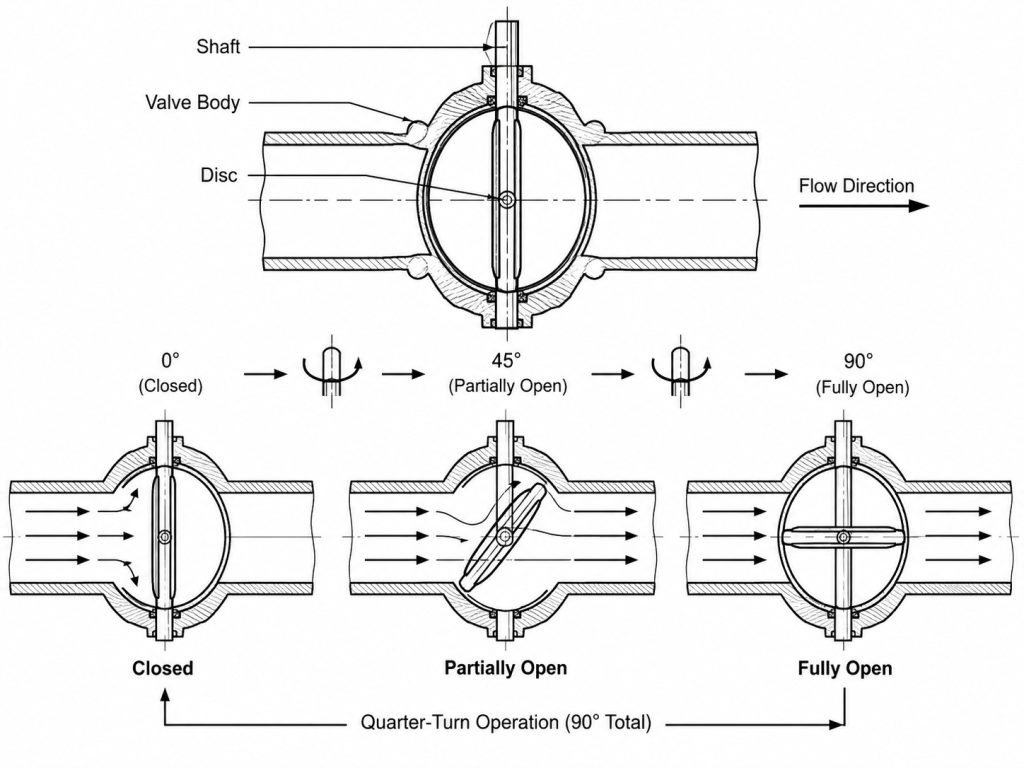
A butterfly valve gains its defining characteristics from a circular disc that rotates approximately 90 degrees between closed and open. The short movement allows fast operation, while the thin body needs less inline space than many linear-motion designs.
The same disc also stays inside the flow path when the valve is fully open. This creates the central engineering tradeoff: you get compact, high-capacity construction, but not a completely unobstructed bore. The disc and shaft influence pressure loss, flow recovery, dynamic torque, and whether the line can pass cleaning pigs.
It helps to classify characteristics before judging them:
| Characteristic type | Examples | What is relatively fixed | What remains service-dependent |
|---|---|---|---|
| Geometric | Short body, rotating disc, quarter-turn travel | Basic motion and compactness | Disc clearance, installation access, pipe support |
| Hydraulic | High capacity, pressure recovery, throttling curve | Disc remains in the flow path | Cv/Kv by angle, noise, cavitation, installed control response |
| Sealing | Resilient or metal seat, concentric or offset contact | Selected seat geometry | Leakage under actual pressure, temperature, cycles, and flow direction |
| Operating | Manual, geared, pneumatic, electric, or hydraulic actuation | Operator type and travel | Breakaway, running, and closing torque under real conditions |
This separation prevents a design feature such as “quarter-turn” from becoming an unsupported promise such as “low torque in every service.”
High Capacity Does Not Mean Linear Flow Control
Butterfly valves offer high flow capacity for their size, but flow does not normally increase in direct proportion to disc angle. As the disc turns, it changes both the open area and the direction of the fluid, so a small movement can have a very different effect near closed, mid-travel, or almost fully open.
For isolation service, the main hydraulic checks are usually full-open Cv or Kv, pressure loss, velocity, and whether the disc obstructs an unacceptable process requirement. For modulating service, a full-open coefficient is not enough. You need a Cv or Kv curve by opening angle and should compare it with minimum, normal, and maximum flow at the pressure drop actually available across the valve. Our detailed guide to butterfly valve flow characteristics and stable sizing explains that calculation path.
The catalog curve is an inherent characteristic measured under defined conditions. The installed characteristic also reflects pumps, pipe friction, fittings, equipment, elevation, and other system losses. If normal flow occurs with the disc barely open, the valve may be oversized for control even though it passes maximum flow. Hunting, noise, vibration, or weak response near full opening are signals to review the valve size, pressure allocation, or valve type.
Shutoff Performance Comes From the Seat and Offset Design
Shutoff performance depends on how the disc meets the seat, not simply on the fact that the valve is a butterfly design. Concentric, double-offset, and triple-offset valves use different contact mechanics, so they do not share the same wear pattern or service limits.
Concentric resilient-seated valves
In a concentric valve, the centered disc typically compresses a resilient seat. This arrangement is economical for compatible water, HVAC, air, and general utility duties. Because the disc contacts the seat during travel, material, cycling, debris, and temperature strongly affect life.
Double-offset valves
A double-offset design moves the shaft away from the disc sealing plane and pipe centerline. The disc cams away from the seat as it opens, reducing sliding contact. This can improve cycle life and extend the useful service range when the seat, body, shaft, and test basis support the duty.
Triple-offset valves
A triple-offset design adds angled sealing geometry so the surfaces approach with minimal rubbing until final closure. It is considered for metal seating, higher temperature, demanding cycling, or specified leakage performance. “Metal seated” does not prove zero leakage; state the acceptance criterion, pressure direction, and test standard.
Compact Construction Changes Installation and Actuation
Compact construction reduces valve weight and face-to-face space, especially as line size increases, but it shifts attention to flange compatibility, disc clearance, alignment, and operator loading. A short valve is easy to fit only when the surrounding pipe and mating components are correct.
Wafer bodies are clamped between flanges, lug bodies use threaded lugs, and double-flanged bodies connect as an integral flanged component. The choice affects bolting, maintenance isolation, support, and dead-end service. Use a verified drawing—not body style alone—to confirm flange standard, face-to-face dimension, bolt details, liner compression, and open-disc clearance. This wafer-versus-lug selection guide covers those checks in more detail.
Fast quarter-turn motion also affects actuation. Breakaway torque must overcome seat friction, while running torque includes bearing, packing, and hydrodynamic effects. Size the actuator from torque data at the actual differential pressure, flow direction, medium, temperature, and frequency. Set closing speed to suit the system; abrupt closure can create a damaging liquid pressure surge.
Materials Define the Actual Service Envelope
The pressure and temperature envelope belongs to the complete valve assembly, not just the body. The seat, disc, shaft, coating, packing, bearings, fasteners, and actuator interfaces can impose a lower limit than the pressure-containing shell.
Start with the medium in its real condition: chemical identity and concentration, temperature range, solids content, viscosity, possible crystallization, cleaning chemicals, and whether the fluid can permeate or swell an elastomer. Then confirm which components are wetted. A compatible body does not compensate for an incompatible seat or exposed shaft, and a corrosion-resistant disc does not prevent abrasive particles from damaging the sealing edge.
This is why “suitable for water” is too broad for a final specification. Clean cooling water, potable water, screened wastewater, seawater, and abrasive sludge create different risks. The RUITO overview of water and wastewater valve duties shows how particulate load, corrosion, sanitary requirements, cycling, and torque demand change across treatment stages.
Verify Every Important Characteristic With Evidence
A useful characteristic connects to a measurable requirement and a supplier document. Words such as compact, high performance, low torque, or tight shutoff are only starting points.
The current API standards plan lists API 609, 10th edition, for butterfly valves with double-flanged, lug, wafer, and butt-welding ends. A design standard defines a common technical basis, but it does not replace the project data needed to select one valve. The RUITO guide to specifying an API 609 butterfly valve expands on the required service inputs.
Use the following evidence map when comparing quotations or technical submissions:
| Claimed characteristic | Evidence to request | Red flag |
|---|---|---|
| High flow capacity or low loss | Cv/Kv or loss data for the exact size and disc position | Only a generic statement or full-open value for control duty |
| Tight shutoff | Leakage criterion, test standard, test pressure, direction, and seat type | “Zero leakage” without an acceptance basis |
| Low operating torque | Breakaway, running, and closing torque basis at stated differential pressure | Actuator selected from nominal size alone |
| Pressure-temperature capability | Rating table for the complete material and seat combination | Body rating presented as the valve rating |
| Easy installation | GA drawing, face-to-face dimension, flange drilling, disc-clearance data | Connection name without dimensional confirmation |
| Material compatibility | Wetted-parts list, material certificates, coating or lining details | Body material specified while seat, shaft, and disc remain undefined |
At RUITO, applicable orders can be supported with engineering drawings, bills of materials, material certificates, and inspection or pressure-test records. These convert catalog characteristics into checkable requirements.
Best-Fit Applications Still Depend on Service Conditions
Butterfly valves fit best where compactness, quick rotary operation, large-line practicality, and good flow capacity are important. Common candidates include clean water, cooling water, HVAC, air, general utilities, water-treatment stages, and many process isolation or moderate throttling duties.
They need closer review when the line requires pigging, precise low-flow control, severe pressure letdown, cavitation resistance, abrasive or stringy solids handling, very high cycling, fire-safe performance, or a demanding pressure-temperature envelope. These conditions do not automatically rule out every butterfly valve, but they may require an offset design, special materials, a different actuator, or another valve type.
A practical selection sequence is to define the required function first, then check the interactions:
- State whether the valve will isolate, modulate, or do both.
- Record medium, concentration, solids, temperature range, and design pressure.
- Calculate the flow range and available differential pressure.
- Set the leakage criterion, pressure direction, and dead-end requirement.
- Confirm body style, flange interface, disc clearance, materials, and maintenance access.
- Check Cv/Kv by angle, torque, rating, test, and documentation requirements on the same service basis.
Turn Characteristics Into a Working Specification
Butterfly valve characteristics are valuable only when they are tied to the actual line. Quarter-turn motion, compact size, high capacity, configurable sealing, and simple automation can solve real piping constraints, while the disc obstruction, nonlinear control curve, seat contact, and service-dependent torque define the limits.
If you are evaluating a butterfly valve for a project, send the medium, temperature, pressure, flow range, line size, connection standard, leakage requirement, and actuator preference through the RUITO project contact page. We can review the configuration and identify the drawings, curves, material data, and test records needed for approval.
FAQ
Can a butterfly valve provide bidirectional shutoff?
Some butterfly valves can provide bidirectional shutoff, but the capability must be confirmed for the exact design and pressure rating. Check the permitted flow direction, differential pressure in each direction, seat orientation, leakage criterion, and whether dead-end service is allowed.
Why can a correctly rated butterfly valve fail to close?
A correct pressure class does not prove that the actuator can close the valve. Excess differential pressure, seat friction, debris, scale, misalignment, bearing damage, low air pressure, inadequate motor torque, or an incorrect safety factor can stop the disc before full seating.
Is a wafer butterfly valve suitable for dead-end service?
Do not assume it is. Dead-end service loads the body, seat, and bolting differently from installation between two pressurized flanges, so use the manufacturer’s explicit dead-end rating and installation instructions.