
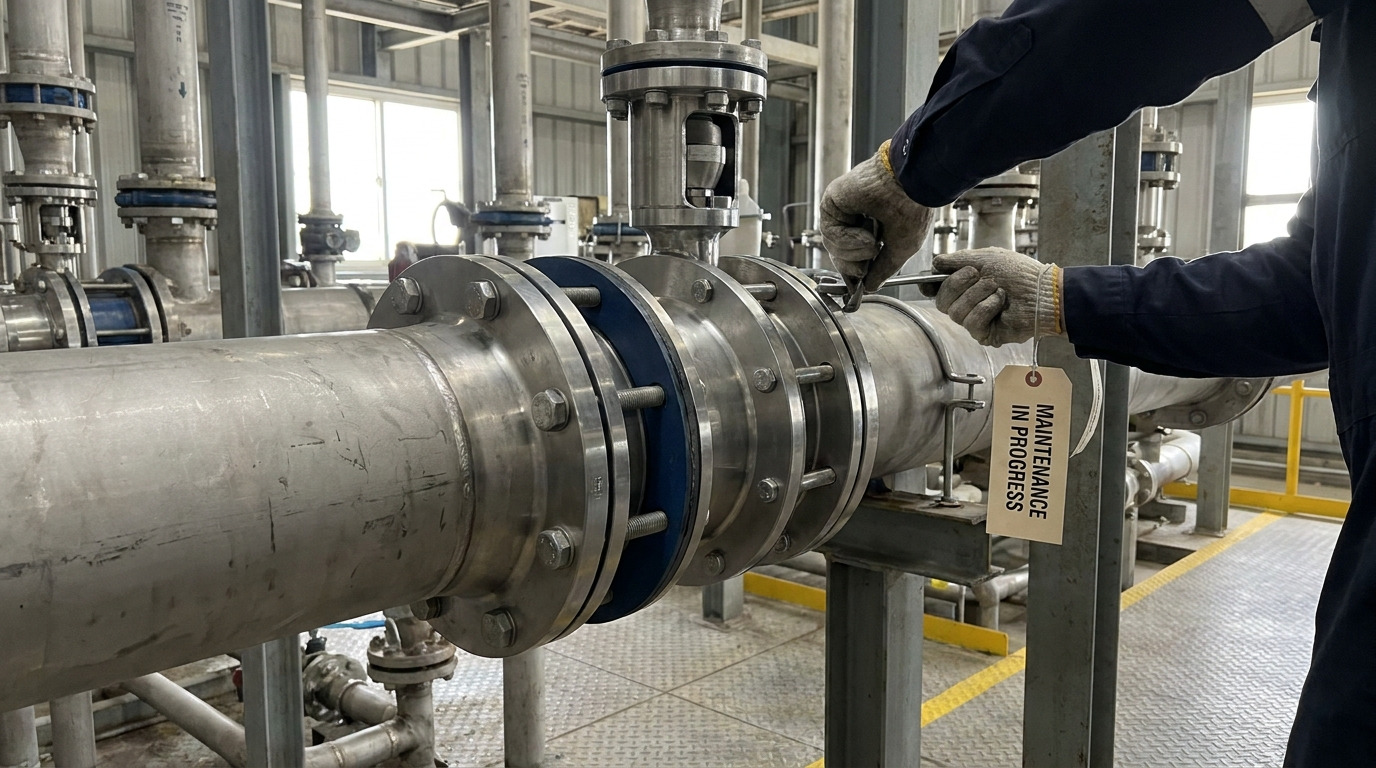
Yes, some butterfly valves need gaskets, while others seal correctly without them. A poorly chosen butterfly valve gasket can distort a resilient seat, restrict disc movement, or leave a flange joint leaking after startup.
Suppose you are preparing a shutdown installation, yet drawings do not state whether separate gaskets belong between valve and pipe flanges. Guesswork could cause rework, lost production, and repeated bolt adjustments. This guide helps you decide from valve design, flange condition, media, pressure, and manufacturer documentation.
What Is a Butterfly Valve Gasket?
A butterfly valve gasket is a compressible sealing element placed between mating valve and pipe-flange faces. It fills small surface imperfections and blocks external leakage once bolts apply a controlled clamping load.
What Job Does the Gasket Perform?
The gasket seals a static joint rather than controlling flow through a valve. Here is the practical point: its performance depends on balanced compression across its entire contact area.
- Fills machining marks and minor flange irregularities
- Contains liquid, gas, or vapor within a pipeline
- Accommodates limited thermal movement
- Maintains sealing stress during pressure cycles
How Does It Differ From a Valve Seat?
A valve seat seals around the disc inside a butterfly valve, while a gasket seals each external flange connection. Confusing these components often results in duplicate sealing layers or incorrect replacement parts.
| Component | Location | Main Function |
|---|---|---|
| Gasket | Flange joint | Prevent external leakage |
| Seat | Inside valve | Stop flow across disc |
| Stem seal | Around shaft | Block leakage along stem |
This distinction directs inspection toward the correct sealing surface.
Key Takeaway: You can diagnose leakage faster when you identify whether fluid escapes across the seat, flange joint, or stem.
Do All Butterfly Valves Need Gaskets?
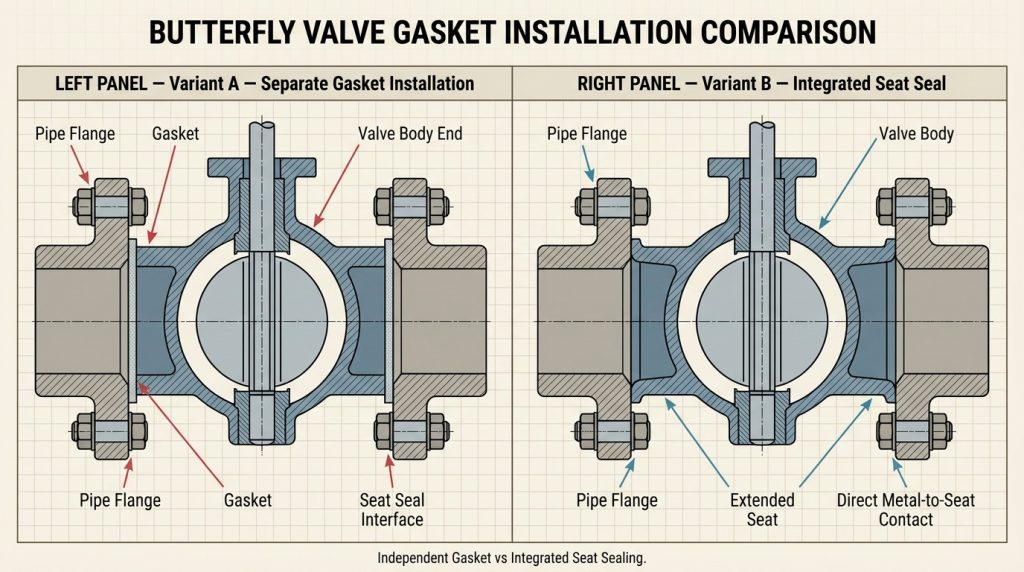
No, not every butterfly valve gasket arrangement requires a separate sealing sheet or ring. Many resilient-seated wafer and lug valves extend their liners across flange-contact faces, creating an integral seal when installed between compatible flanges.
When Can the Seat Provide the Flange Seal?
An extended elastomer seat can act as its own flange seal when its design supports direct flange contact. But here is the catch: adding separate gaskets may reduce seat compression or push liner material inward.
- Confirm instructions for the exact valve model
- Inspect seat faces for cuts or deformation
- Verify both pipe flanges match valve requirements
- Never assume every soft seat works identically
When Is a Separate Gasket Safer?
Separate gaskets generally suit double-flanged valves, metal-seated designs, and joints whose drawings specify them. Damaged or uneven flanges require engineering review rather than an improvised extra layer.
| Valve Configuration | Typical Gasket Decision | Confirmation Source |
|---|---|---|
| Resilient wafer | Often unnecessary | Product manual |
| Resilient lug | Often unnecessary | Approved drawing |
| Double flanged | Commonly required | Joint specification |
| Metal seated | Commonly required | Manufacturer data |
The configuration narrows your choice, but model documentation controls it.
Key Takeaway: Check seat geometry and installation instructions before adding any separate gasket.
Which Butterfly Valve Types Usually Require Gaskets?
Flanged and metal-seated designs usually require a butterfly valve gasket, while resilient wafer or lug designs may seal without one. Connection style alone cannot settle the question because seat construction changes how flange sealing occurs.
Do Flanged Valves Need Separate Gaskets?
Double-flanged valves normally need a gasket at each pipe connection. What matters next? Gasket dimensions must match flange facing, bore, pressure class, and available seating width.
- Use one compatible gasket at each joint
- Keep gasket material outside disc travel
- Match dimensions with approved flange drawings
- Apply project-approved bolting procedures
What About Wafer, Lug, and Triple-Offset Designs?
Wafer and lug valves may use an extended resilient seat, whereas triple-offset metal-seated valves commonly rely on separate flange gaskets. A triple-offset design seals internally through metal geometry but still needs suitable external joint sealing.
| Valve Type | Usual Arrangement | Main Check |
|---|---|---|
| Wafer, soft seated | Integral seal may suffice | Seat-face design |
| Lug, soft seated | Integral seal may suffice | Dead-end rating |
| Double flanged | Separate gaskets | Flange facing |
| Triple offset | Separate gaskets | Temperature and class |
This comparison helps procurement teams request the correct joint package.
Key Takeaway: Define body style and seat design together when specifying flange gaskets.
Which Gasket Materials Suit Common Media?
The correct butterfly valve gasket uses material compatible with process fluid, temperature, pressure, and cleaning chemicals. A gasket that survives water service may swell, harden, or lose stress in hydrocarbons or aggressive chemical lines.
Which Soft Materials Fit Routine Service?
EPDM often suits water and many HVAC duties, while NBR commonly serves compatible oils and fuels. The useful shortcut: screen chemical resistance before comparing price or availability.
- EPDM: water, dilute chemicals, and many HVAC fluids
- NBR: oils, fuels, and compatible compressed air
- FKM: higher heat and selected aggressive fluids
- PTFE: broad chemical resistance with lower elasticity
When Do Graphite or Spiral-Wound Gaskets Fit?
Flexible graphite and spiral-wound constructions suit hotter or more demanding flanged joints when flange design supports their required seating load. They should not be placed against a soft-seat valve without written approval.
| Material | Typical Strength | Main Limitation |
|---|---|---|
| EPDM | Water and weather resistance | Poor fit for many oils |
| NBR | Oil resistance | Limited high-heat service |
| PTFE | Broad chemical resistance | Creep under sustained load |
| Graphite | High-temperature capability | Needs suitable handling |
| Spiral wound | Pressure and thermal cycling | Requires adequate bolt load |
This material screen should precede a detailed chemical-compatibility review.
Key Takeaway: Match every gasket material against actual media concentration, temperature, and operating cycles.
How Do Pressure and Temperature Affect Gasket Choice?
Pressure and temperature determine how much sealing stress a butterfly valve gasket must retain throughout service. Higher values do not automatically demand a thicker gasket because thickness can increase creep, blowout exposure, and joint movement.
How Does Pressure Change the Joint Demand?
Internal pressure works against bolt-generated compression and tries to separate mating faces. Watch this detail: pressure class alone does not define gasket stress or bolt torque.
- Check maximum operating and test pressure
- Account for pressure surges and vacuum duty
- Verify gasket pressure-temperature ratings
- Use approved flange and fastener data
Why Do Thermal Cycles Matter?
Heating and cooling alter bolt length, flange position, gasket stiffness, and retained compression. Repeated cycles can relax a joint even when initial testing shows no leakage.
| Service Factor | Possible Effect | Specification Response |
|---|---|---|
| High pressure | Joint separation force | Higher retained stress |
| High temperature | Material softening or oxidation | Heat-rated material |
| Thermal cycling | Bolt-load variation | Stable gasket construction |
| Vacuum | Air ingress | Low-permeability seal |
This relationship explains why steady and cycling services need different reviews.
Key Takeaway: Specify normal, maximum, startup, shutdown, and test conditions before selecting a gasket.
How Should You Size a Butterfly Valve Gasket?
A butterfly valve gasket should match flange standard, nominal size, facing, bolt pattern, and valve bore. Its inside diameter must clear disc movement without leaving an exposed edge that disrupts flow or damages the seat.
Which Dimensions Must You Confirm?
Use approved valve and flange drawings rather than nominal pipe size alone. Here is where errors surface: identical nominal sizes can use different drilling and facing details across standards.
- Gasket inside and outside diameters
- Thickness after specified compression
- Bolt-hole count and diameter
- Raised-face or full-face pattern
- Available seating width
Can Gasket Thickness Affect Disc Clearance?
Yes, excess thickness can change valve spacing, liner compression, bolt engagement, and disc-to-pipe clearance. Thin gaskets can also fail when flange finish or flatness falls outside acceptable limits.
| Dimension | Why It Matters | Verification |
|---|---|---|
| Inside diameter | Protects flow path and disc | Valve drawing |
| Outside diameter | Centers gasket correctly | Flange standard |
| Thickness | Controls compression and spacing | Joint specification |
| Bolt pattern | Prevents interference | Flange drawing |
A dimensional stack check exposes conflicts before fasteners are ordered.
Key Takeaway: Send valve, flange, gasket, and fastener drawings for one coordinated dimensional review.
How Should You Install a Gasket Without Damaging the Seat?
A butterfly valve gasket should be installed between clean, aligned flanges using controlled cross-pattern tightening. Never pull misaligned pipework into position with valve bolts because that can distort the body, pinch the liner, and create uneven compression.
What Should You Check Before Assembly?
Inspect all contact surfaces and confirm that pipework can support its own weight. Before tightening begins: position the disc as directed by valve documentation, commonly slightly open where clearance permits.
- Isolate, drain, and secure the line
- Clean both flange faces
- Remove old gasket residue
- Center valve and gasket
- Confirm disc clearance through travel
How Should Bolts Be Tightened?
Bring bolts to contact evenly, then tighten through staged cross-pattern passes using approved values. Cycle the disc carefully after an intermediate pass if project procedures permit.
| Installation Stage | Main Action | Desired Result |
|---|---|---|
| Alignment | Center valve and pipe | Free disc movement |
| Snug pass | Seat components evenly | Uniform contact |
| Staged passes | Apply cross-pattern load | Balanced compression |
| Verification | Operate and test | No binding or leakage |
The staged sequence reduces local over-compression around individual bolts.
Key Takeaway: Proper alignment and balanced loading protect both flange gasket and resilient valve seat.
Which Gasket Selection Mistakes Cause Leaks?
The most common butterfly valve gasket mistakes involve duplicate seals, incompatible materials, wrong dimensions, reused components, and uncontrolled bolt load. These errors may cause immediate leakage or delayed failure after temperature and pressure cycles.
Why Can an Extra Gasket Make Sealing Worse?
A separate gasket can interfere with an extended resilient seat that already seals against both pipe flanges. The risk is simple: extra thickness changes designed compression and may force soft material into the disc path.
- Do not stack multiple gaskets
- Do not use sealant unless approved
- Do not cover an integral seat blindly
- Do not reuse compressed or damaged gaskets
Why Does More Torque Fail to Cure Every Leak?
More torque can crush gasket material, warp a wafer body, damage threads, or increase disc resistance. Leakage caused by misalignment or incompatibility needs correction rather than greater bolt load.
| Mistake | Likely Result | Better Action |
|---|---|---|
| Added gasket over liner | Seat distortion | Follow valve instructions |
| Wrong bore size | Disc interference | Check drawings |
| Mixed gasket materials | Uneven compression | Use one specified type |
| Excess torque | Crushed seal or warped body | Apply approved procedure |
This pattern shows why diagnosis must come before retightening.
Key Takeaway: Treat recurring leakage as a joint-design problem instead of relying on extra material or torque.
How Can You Diagnose Gasket Leakage?
A leaking butterfly valve gasket can be diagnosed through safe visual inspection, pressure history, bolt-load review, and examination after isolation. Confirm that leakage comes from the flange joint because stem seals, body defects, and downstream seat leakage require different remedies.
What Clues Point Toward the Root Cause?
Leak location and timing provide useful evidence. Here is the telling clue: leakage that begins during heat-up may indicate relaxation, thermal movement, or incompatible material.
- Local leak near one bolt: uneven loading or flange damage
- Leakage around full circumference: low compression or wrong size
- Delayed seepage: creep, cycling, or chemical attack
- Disc binding: liner distortion or internal interference
What Should a Safe Inspection Record Include?
Record media, pressure, temperature, valve position, leak location, and recent maintenance before disturbing the joint. Photograph flange gaps and fastener positions where site rules allow.
| Observation | Possible Cause | Next Check |
|---|---|---|
| One-sided seepage | Misalignment | Flange parallelism |
| Swollen material | Chemical attack | Compatibility data |
| Extruded edge | Excess load or wrong size | Gasket dimensions |
| Loose fasteners | Relaxation or vibration | Bolting record |
These observations narrow investigation without assuming one universal cause.
Key Takeaway: Document operating conditions and leak geometry before dismantling the joint.
When Should You Replace or Upgrade a Gasket?
A butterfly valve gasket should be replaced after joint disassembly or when inspection reveals hardening, swelling, cracks, extrusion, erosion, or permanent deformation. A used gasket rarely returns predictably to its original compression after bolts are released.
Which Conditions Call for Immediate Replacement?
Replace any gasket affected by an incompatible medium, overheating, mechanical damage, or uncontrolled leakage. The decision becomes clearer: continued tightening cannot restore degraded material.
- Visible cuts, cracks, or tears
- Permanent flattening or extrusion
- Swelling, softening, or brittleness
- Contamination embedded in sealing faces
- Leakage after approved tightening checks
When Does the Whole Joint Need an Upgrade?
Frequent failures may require changes to gasket material, flange condition, fasteners, alignment, or valve design. Review recurring service changes such as higher temperatures, stronger chemicals, or more frequent cycling.
| Condition | Replacement | Engineering Upgrade |
|---|---|---|
| Normal planned opening | Yes | Usually unnecessary |
| Isolated surface damage | Yes | Repair flange if needed |
| Repeated thermal leaks | Yes | Review joint design |
| Changed process media | Yes | Recheck all wetted materials |
This decision separates routine maintenance from a recurring system-level fault.
Key Takeaway: Replace disturbed gaskets and investigate repeated failures across the complete flange assembly.
Ready to Build a More Reliable Valve Joint?
Butterfly valves do not follow one universal gasket rule. Flanged and metal-seated designs commonly need separate gaskets, while many resilient wafer and lug valves use extended seats as integral seals. Valve documentation, media compatibility, flange condition, dimensions, and controlled bolt loading should guide your decision.
This guide has addressed where gaskets belong, which materials fit common duties, how installation errors create leaks, and when replacement makes sense. For application review, valve drawings, or a coordinated sealing specification, contact us today. Reliable flow control begins with engineering choices that remain dependable after commissioning.
Frequently Asked Questions
Can I install a gasket on every butterfly valve?
No. Some resilient wafer and lug valves already use extended seats as flange seals. An extra gasket can reduce intended compression, distort a liner, or obstruct disc movement, so check model instructions before installation.
What’s the best gasket for a water butterfly valve?
EPDM often fits compatible potable-water, wastewater, and HVAC applications. Your selection still depends on approvals, disinfectants, temperature, pressure, and valve construction.
How do I know if my valve has a built-in flange seal?
Check whether its resilient seat or liner extends across both flange-contact faces. Confirm that observation against an approved drawing or installation manual because similar-looking valves may use different sealing arrangements.
Can I reuse a butterfly valve gasket after maintenance?
No. Replace it after opening a gasketed flange joint unless its manufacturer explicitly permits reuse. Released compression, surface damage, and contamination can prevent predictable resealing.
What’s the best way to stop a leaking flange joint?
Identify its cause before applying more torque. Verify isolation, alignment, flange condition, gasket compatibility, dimensions, fastener condition, and approved tightening values before rebuilding and pressure-testing the joint.