
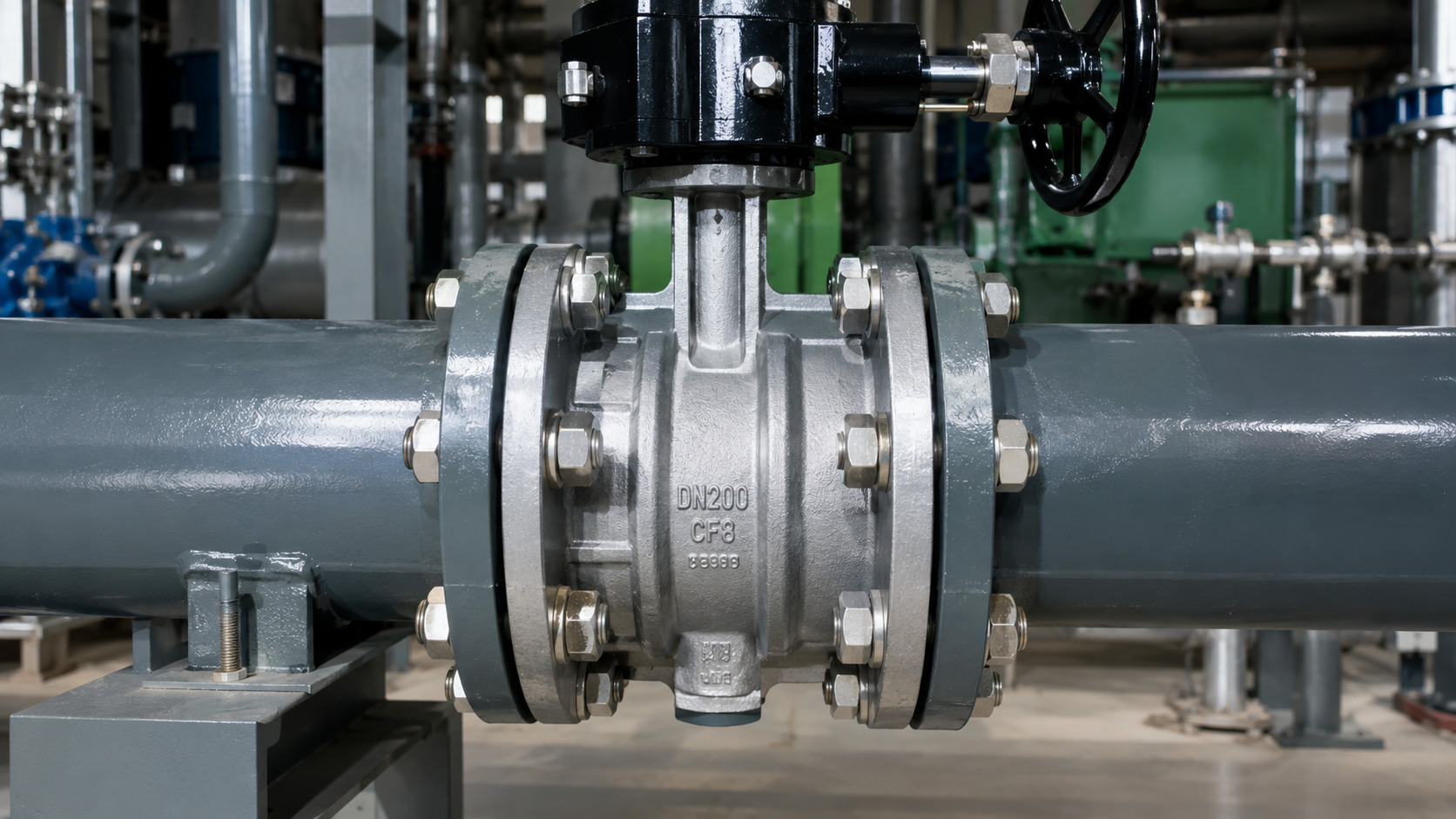
A wafer valve sits between two pipe flanges and uses through-bolts, while a flanged valve has integral end flanges bolted directly to each pipe flange. A rushed choice can leave you facing alignment trouble, leakage, or an isolation plan that fails during maintenance. Matching the butterfly valve flange connection to pressure, temperature, pipe size, and service access gives you a safer specification. This guide shows where each design fits and how you can compare them without relying on purchase price alone.
How Does a Butterfly Valve Flange Connection Differ?
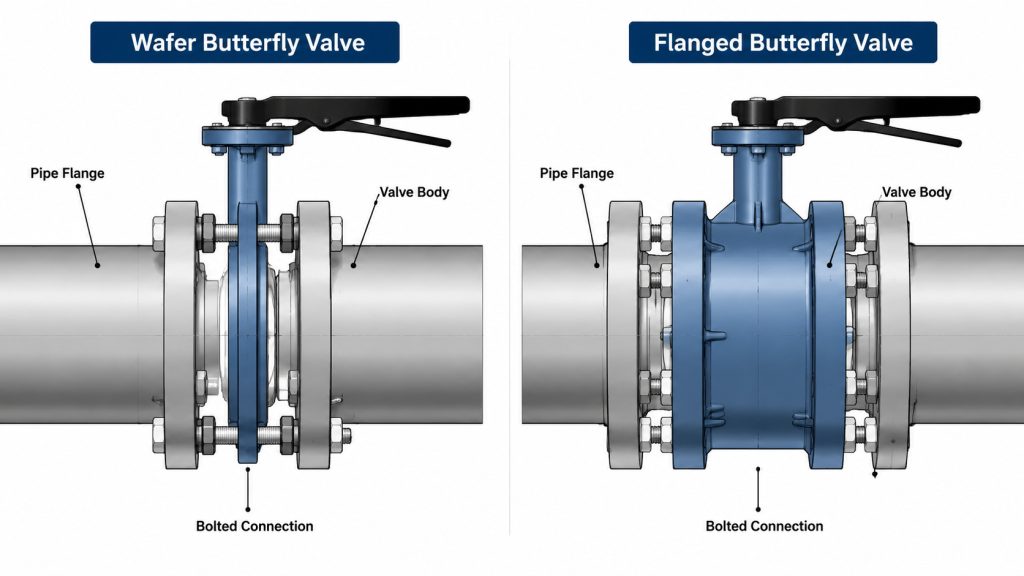
The butterfly valve flange connection differs mainly in how its body joins and supports the pipeline. A wafer body is clamped between mating flanges by long through-bolts, while a flanged body carries its own drilled ends and uses separate bolt sets on both sides.
What Does Each Body Look Like?
A wafer body is narrow and usually has centering holes or lugs that guide installation rather than forming full pipe connections. A flanged body is longer and heavier because each end includes a full flange. Here’s the practical point: body geometry controls both installation work and load transfer.
- Wafer: compact body between existing pipe flanges
- Flanged: integral ends joined directly to pipe flanges
- Both: internal disc rotates through roughly 90 degrees
| Feature | Wafer Type | Flanged Type |
|---|---|---|
| Body ends | No full end flanges | Two integral flanges |
| Main fasteners | Long through-bolts | Shorter bolts at each end |
| Pipeline support | Shared clamping assembly | Direct connection on both sides |
This comparison shows why drawings must identify connection style before dimensions are approved.
Key Takeaway: You can prevent fit-up errors by checking body style, flange drilling, and face-to-face length as one package.
Why Is a Wafer Valve Lighter and Less Expensive?
A wafer valve is lighter and often less expensive because its butterfly valve flange arrangement uses less body material and fewer machined flange surfaces. Lower weight can also reduce handling time, support loads, and freight cost on large orders.
Where Do the Savings Come From?
Wafer construction removes two full body flanges, which cuts casting mass and machining work. Its compact face-to-face length also packs efficiently for export. But price tells only part of the story: installation access and future isolation needs can change total project cost.
- Less metal in each valve body
- Fewer flange faces and bolt holes to machine
- Lower lifting and transport demands
| Cost Driver | Wafer Type | Flanged Type |
|---|---|---|
| Material use | Lower | Higher |
| Machining | Simpler | More extensive |
| Handling | Easier | More lifting support |
The cost gap matters most across high valve quantities or large diameters.
Key Takeaway: You gain real value from a wafer design only when its lower purchase and handling costs suit your maintenance plan.
How Do Bolts and Alignment Affect Installation?
Bolts and alignment affect installation because a butterfly valve flange assembly must center the disc without twisting the body or loading fasteners unevenly. Long wafer bolts span both pipe flanges, so poor parallelism can create shear stress, uneven gasket compression, and leakage.
What Should Your Installer Check?
Pipe flanges should be parallel, centered, clean, and spaced wide enough for the valve without forcing it into place. The disc should clear the pipe bore before final tightening. Watch what happens next: a cross-pattern torque sequence draws the joint together evenly and protects the seat.
- Verify flange standard, pressure class, and bolt-circle match
- Support adjacent pipework before inserting the valve
- Tighten fasteners gradually in a crossed sequence
| Installation Check | Risk if Missed | Field Action |
|---|---|---|
| Flange parallelism | Body distortion | Realign pipe supports |
| Disc clearance | Disc or seat damage | Confirm bore before cycling |
| Even torque | Local leakage | Use a staged cross pattern |
This check sequence links alignment quality directly with sealing reliability.
Key Takeaway: You reduce startup leaks when fit-up is corrected before any bolt receives final torque.
Which Design Handles Dead-End Service Better?
A flanged valve generally handles dead-end service better because its butterfly valve flange connections remain independently secured to each pipe section. A standard wafer valve may lose restraint when downstream pipework is removed, so it should not be treated as safe end-of-line isolation unless its rating explicitly permits that duty.
Can You Remove Downstream Pipework Safely?
With a flanged design, you can disconnect one side while the opposite flange remains bolted to the valve body, subject to manufacturer limits and site isolation procedures. A wafer assembly relies on shared through-bolts across both sides. What does that mean for you? Maintenance sequencing must reflect how each joint carries load.
- Confirm dead-end pressure rating in supplier documents
- Depressurize, drain, and lock out before disassembly
- Support valve and downstream spool before loosening bolts
| Service Condition | Wafer Type | Flanged Type |
|---|---|---|
| Both sides connected | Suitable when rated | Suitable when rated |
| One side removed | Usually restricted | Better suited |
| Independent restraint | Limited | Stronger |
The table points toward a clear maintenance boundary, not a substitute for product data.
Key Takeaway: You should select a flanged or rated lug design where downstream removal forms part of normal service work.
How Do Sealing and Structural Stability Compare?
Flanged designs usually provide greater structural stability, while sealing performance depends on the full butterfly valve flange assembly, seat design, pressure direction, and installation quality. A correctly installed wafer valve can still deliver tight shutoff within its rated service envelope.
What Really Controls Leakage Risk?
Leakage can originate at the valve seat or at either pipeline flange, so technicians must identify which boundary has failed. Flanged bodies resist piping movement well, while wafer bodies depend more heavily on accurate clamping. Here’s the catch: extra metal cannot correct damaged seats, dirty faces, or unsuitable gasket practice.
- Seat material must match fluid and temperature
- Flange faces must remain clean and undamaged
- Pipe loads should not be transferred through valve bodies
| Leakage Factor | Wafer Type | Flanged Type |
|---|---|---|
| Sensitivity to alignment | Higher | Lower |
| Joint rigidity | Moderate | Higher |
| Seat dependence | High | High |
This matrix separates connection strength from seat tightness.
Key Takeaway: You get dependable sealing by controlling alignment, materials, and pipe loads rather than choosing on body style alone.
How Do Temperature and Pipe Size Change the Choice?
Temperature and pipe size change the choice because thermal growth and larger pipe loads place more stress on a butterfly valve flange joint. Long wafer bolts can expand during thermal cycling, while large bodies demand tighter alignment control and better external support.
Which Limits Need Engineering Review?
Seat material often sets a lower temperature ceiling than the metal body, so media data must accompany pressure and size. Large-diameter or hot lines may favor a flanged body for rigidity and independent bolting. The deciding detail is this: published limits apply only when every pressure-retaining and sealing part fits the same duty.
- Record normal, maximum, and cycling temperatures
- Check pressure-temperature ratings for body and seat
- Review pipe reactions, supports, and expansion movement
| Service Variable | Wafer Concern | Flanged Advantage |
|---|---|---|
| Thermal cycling | Long-bolt relaxation | Shorter independent joints |
| Large diameter | Greater alignment sensitivity | Higher body rigidity |
| Seat temperature | Material limit applies | Material limit still applies |
The data review should narrow your connection choice before quotation.
Key Takeaway: You avoid heat-related leaks by evaluating joint movement and seat limits together.
Which Design Makes Maintenance Easier?
Maintenance is usually faster on a flanged design when one pipe side must be removed, while a wafer butterfly valve flange assembly can be quicker to replace in a fully isolated line. Actual access depends on spool clearance, lifting space, actuator position, and bolt condition.
What Changes During Removal and Reassembly?
Removing a wafer valve often requires loosening or extracting long bolts across the complete joint, then spreading pipe flanges without damaging the seat. Flanged valves use separate fasteners on each side, though their weight may require lifting equipment. Now consider the hidden work: every disturbed joint needs cleaning, inspection, alignment, and controlled tightening.
- Plan lifting points and safe valve support
- Inspect disc edges, seats, faces, and fasteners
- Replace damaged gaskets where the design uses them
| Maintenance Task | Wafer Type | Flanged Type |
|---|---|---|
| Valve removal | Compact but joint-wide | Heavier but side-specific |
| Downstream access | More restrictive | More flexible |
| Lifting demand | Lower | Higher |
The easier option depends on what your crew must disconnect.
Key Takeaway: You can shorten outages by matching body style with the maintenance sequence shown in your site procedure.
What Do Lifecycle Costs Mean for Your Project?
Lifecycle cost means the butterfly valve flange decision should include installation, inspection, downtime, spares, and future pipe access rather than purchase price alone. A cheaper wafer unit may win in stable utility service, while a flanged unit may pay back its premium where shutdown access carries high cost.
How Should You Compare Total Cost?
Build a simple cost model around realistic intervention frequency and labor hours. Include lifting, gaskets, fasteners, lost production, and any temporary spool work. Here’s where numbers help: even a rough scenario comparison can expose a low-price choice that becomes costly after one outage.
- Purchase, freight, and installation labor
- Planned inspection and replacement intervals
- Downtime exposure and access equipment
| Cost Element | Wafer Tendency | Flanged Tendency |
|---|---|---|
| Initial spend | Lower | Higher |
| Routine access cost | Application-dependent | Often lower for side removal |
| Freight and handling | Lower | Higher |
This breakdown turns a price comparison into an operating decision.
Key Takeaway: You protect project value when procurement and maintenance teams review connection cost together.
Where Does Each Valve Type Perform Best?
Wafer valves often perform best in compact water, HVAC, and utility lines, while flanged valves suit larger, permanent, or mechanically demanding butterfly valve flange installations. Neither design has a universal application advantage.
Which Service Profile Matches Each Design?
Choose wafer construction where space, weight, and budget matter and both pipe sides remain available during service. Choose flanged construction where rigidity, large diameter, thermal cycling, or one-side access carries greater weight. A useful shortcut follows: start with system risk, then compare connection cost.
- Wafer: compact skids, building services, general water duty
- Flanged: plant headers, large pipelines, demanding process duty
- Either: only after material and pressure checks pass
| Selection Driver | Wafer Preference | Flanged Preference |
|---|---|---|
| Tight installation space | Strong | Moderate |
| High mechanical stability | Moderate | Strong |
| Frequent side access | Weak | Strong |
The service profile usually identifies a preferred body before brand or actuator review.
Key Takeaway: You make a sound choice by matching connection behavior with real operating and maintenance conditions.
How Should You Specify the Right Valve?
You should specify the right butterfly valve flange design through a datasheet covering connection, standard, size, pressure, temperature, media, materials, operation, and testing. Clear data lets suppliers confirm compatibility rather than infer project needs.
What Belongs in Your Purchase Specification?
State flange drilling and face-to-face standards alongside body style, since nominal size alone cannot confirm fit. Add seat leakage criteria, actuator requirements, coating, documentation, and inspection scope. Before you release the order: request a dimensional drawing and verify it against mating pipework.
- Connection type, flange standard, size, and pressure class
- Fluid, temperature range, solids, and corrosion conditions
- Test standard, certificates, drawings, and traceability records
| Specification Field | Why It Matters | Approval Record |
|---|---|---|
| Flange and face-to-face | Confirms physical fit | Approved drawing |
| Materials and limits | Confirms service match | Datasheet and certificates |
| Testing and leakage | Confirms acceptance basis | Test report |
This checklist turns selection logic into auditable purchasing data.
Key Takeaway: You reduce technical queries and site rework when every interface and acceptance criterion appears on one approved datasheet.
Ready to Choose the Right Valve Connection?
Wafer and flanged butterfly valves differ in body connection, weight, installation tolerance, pipe restraint, service access, and lifecycle cost. You now have a practical way to judge both designs against pressure, heat, size, alignment, maintenance, and documentation needs.
Share your line data and project standards when you contact us today for valve selection, drawings, material review, and a documented quotation. Reliable flow control starts with honest application data and engineering choices built for the full service life.
Frequently Asked Questions
Can I Use a Wafer Valve at the End of a Pipeline?
Usually no. Standard wafer bodies rely on clamping between two flanges and may lack a rated dead-end capability, so use a design whose manufacturer expressly approves end-of-line pressure.
What’s the Best Valve Type for a Large-Diameter Water Line?
It depends on pipe loads and access. A flanged valve often provides better rigidity on large mains, while a wafer design may suit supported, moderate-pressure lines where low weight matters.
How Do I Know if My Pipe Flanges Match the Valve?
Check the approved drawing. Compare nominal size, pressure class, flange standard, bolt circle, bore, face-to-face dimension, and disc clearance before ordering.
Can I Replace a Wafer Valve With a Flanged Valve?
Yes, if the piping layout can accommodate it. You must verify face-to-face length, flange drilling, supports, actuator clearance, and any spool modifications.
What’s the Best Way to Prevent Leakage After Installation?
Correct alignment is the best starting point. Clean faces, compatible materials, supported pipework, staged cross-pattern tightening, and a controlled pressure test address common joint and seat leakage causes.