
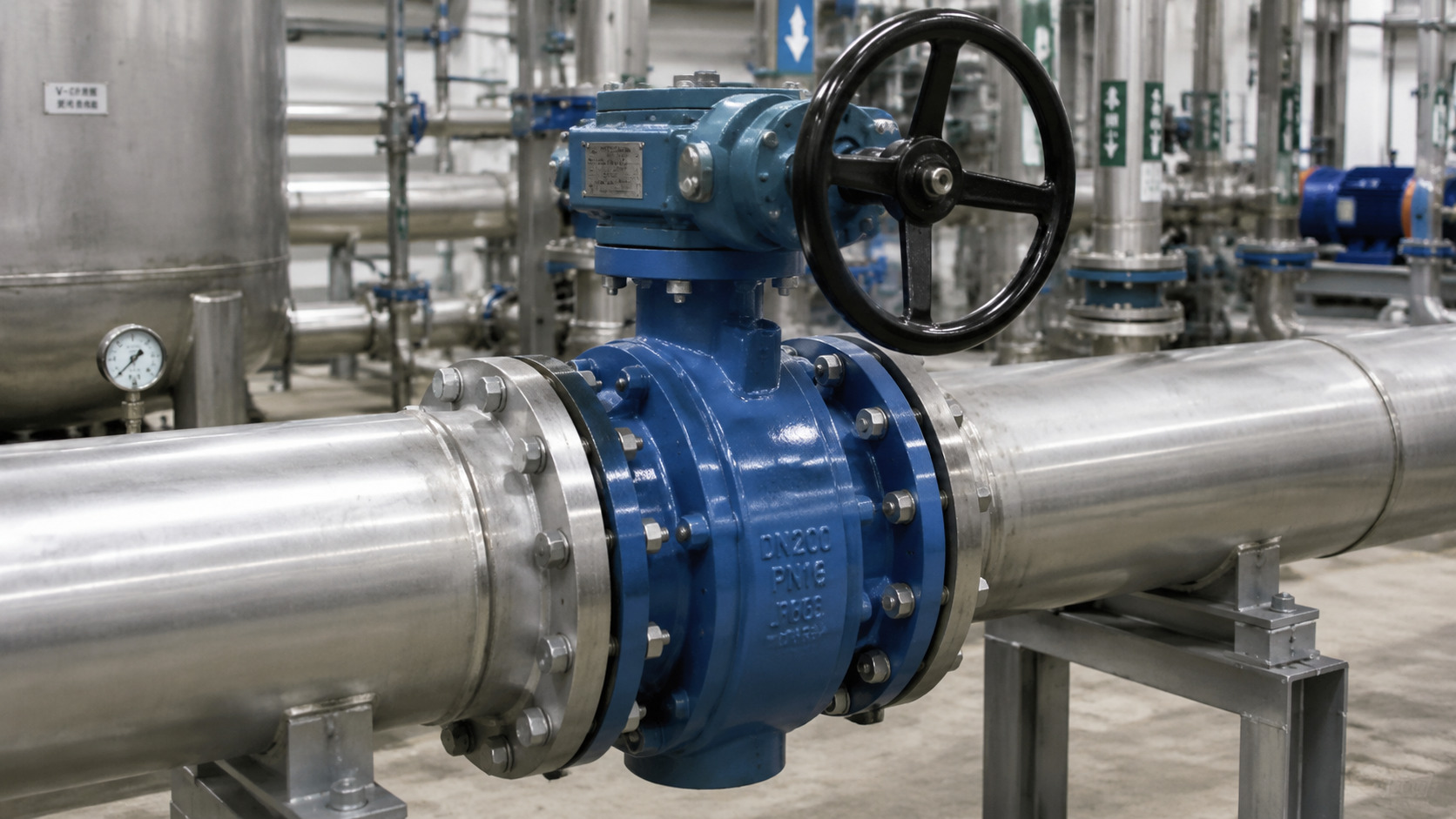
A gear-operated butterfly valve pairs a quarter-turn disc valve with a reduction gearbox, giving you controlled movement and higher output torque with modest handwheel effort. A plant operator may face a DN600 cooling-water valve that resists a lever under full differential pressure; forcing it risks stem damage, sudden closure, and water hammer. A correctly sized butterfly valve gearbox solves that problem through mechanical advantage and steadier travel. This guide helps engineers and procurement teams match gearbox design, torque, materials, mounting, installation, and care with real service conditions.
What Is a Butterfly Valve Gearbox and How Does It Work?
A butterfly valve gearbox transfers handwheel or actuator input through reduction gears, rotating a valve stem through roughly 90 degrees. Its gear ratio multiplies torque while slowing disc travel, which gives you measured positioning and lower operating effort.
Which Parts Carry Force Through the Operator?
Power follows a short mechanical path from input shaft through worm or planetary gears into an output sleeve connected with the stem. Here is where mechanics matter: backlash, bearing support, and tooth contact affect feel, positioning accuracy, and service life.
- Handwheel or input shaft receives operator force
- Gear set multiplies torque and reduces speed
- Output sleeve transfers rotation into the valve stem
- Travel stops limit disc movement near open and shut positions
How Does Reduction Change Valve Behavior?
A higher reduction ratio lowers rim force yet requires more handwheel turns. Self-locking worm geometry can also resist reverse movement caused by line pressure.
| Gearbox feature | Operational effect | Buyer check |
|---|---|---|
| Reduction ratio | More torque, slower travel | Turns for 90° stroke |
| Travel stops | Limits over-rotation | Adjustable and lockable |
| Position indicator | Shows disc angle | Visible from access point |
This comparison shows why ratio and travel control should be reviewed as one system.
Key Takeaway: You can specify a workable operator only after tracing how input force reaches and controls the disc.
Why Choose Gearing Instead of a Direct Lever?
A butterfly valve gearbox suits larger valves, high differential pressure, frequent positioning, or duties where gradual motion matters. A direct lever remains practical for smaller low-torque valves with clear access and basic on-off service.
Where Does a Gearbox Add Practical Value?
Gearing reduces physical strain and helps crews avoid abrupt valve movement. The practical payoff appears under load: a handwheel lets you approach a target angle steadily instead of fighting a long lever.
- Large discs with high seating or hydrodynamic torque
- Throttling duties needing repeatable angular adjustment
- Lines vulnerable to hydraulic shock during fast closure
- Locations where a lever swing would obstruct nearby equipment
What Trade-Offs Should Procurement Expect?
Gear operators cost more, occupy extra space, and take longer for a full stroke. Their controlled motion usually repays that penalty on demanding lines.
| Decision factor | Lever operator | Gear operator |
|---|---|---|
| User effort | Rises sharply with torque | Reduced by gear ratio |
| Stroke speed | Fast | Gradual |
| Position control | Coarse | Fine |
| Maintenance | Minimal | Inspection and lubrication |
This pattern favors gearing once safe handling matters more than rapid manual travel.
Key Takeaway: You gain torque and control with gearing while accepting more turns, space, and upkeep.
Which Gearbox Type Fits Your Operating Duty?
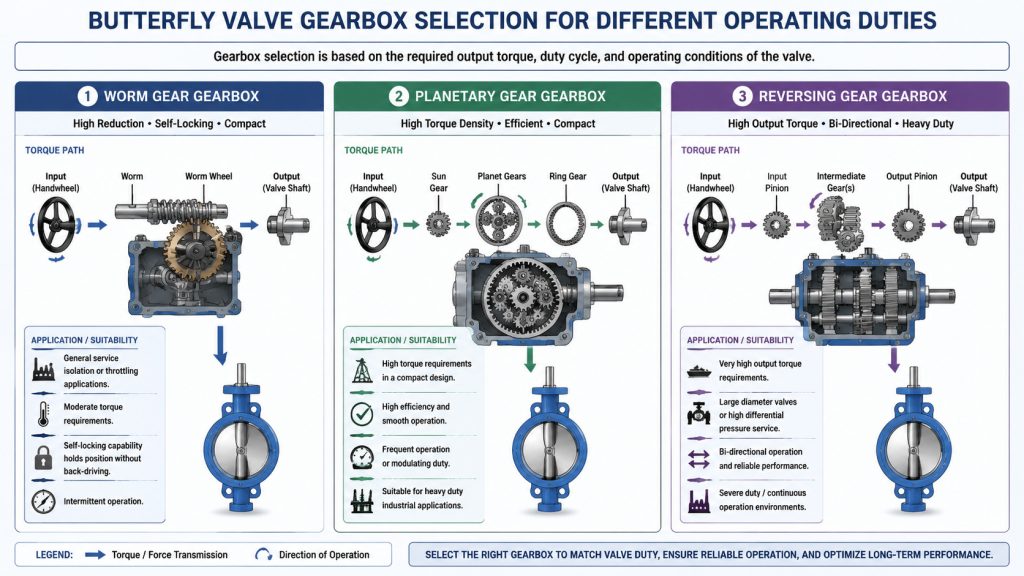
A butterfly valve gearbox should match torque demand, installation envelope, operating frequency, and future automation plans. Worm gears cover many manual duties while planetary arrangements serve exceptionally large or heavily loaded valves.
What Distinguishes Common Gearbox Designs?
Worm gearing offers compact right-angle transmission and useful self-locking behavior. What changes at heavy torque? Planetary stages distribute load across several gears, creating high output from a relatively compact package.
- Worm gear: economical choice for routine quarter-turn service
- Bevel gear: changes shaft direction where access dictates
- Planetary gear: high torque density for severe duty
- Declutchable gear: manual override paired with powered actuation
How Can You Narrow the Choice Quickly?
Start with certified valve torque across actual pressure and temperature, then screen operators by rated output and duty cycle. Review access, closure time, manual override, and ambient exposure before price.
| Duty | Likely design | Main reason |
|---|---|---|
| General water line | Worm gear | Simple, self-locking drive |
| Very large diameter | Planetary gear | High torque density |
| Automated isolation | Declutchable worm gear | Manual emergency control |
This shortlist guides evaluation, though manufacturer torque data still governs final sizing.
Key Takeaway: You reduce actuator risk when gearbox architecture follows actual load and operating mode.
How Should Torque and Gear Ratio Be Sized?
A butterfly valve gearbox must exceed maximum required valve torque after service factors cover pressure, seat friction, aging, and media buildup. Size against breakaway, running, and closing torque rather than pipe diameter alone.
Which Torque Values Belong in Your Calculation?
Breakaway torque starts a seated disc while dynamic torque acts during flow and seating torque completes closure. Here is the hidden risk: a clean workshop test can understate force after months of corrosion or solids accumulation.
- Obtain torque data at maximum differential pressure
- Correct for temperature and seat material
- Apply a documented service factor for duty uncertainty
- Confirm stem and key capacity above selected output torque
What Does Ratio Change for an Operator?
Approximate rim force depends on required torque, gear ratio, efficiency, and handwheel radius. Larger ratios ease input effort but lengthen response time.
| Input variable | If increased | Result |
|---|---|---|
| Gear ratio | More reduction | Lower effort, more turns |
| Handwheel radius | More mechanical advantage | Lower rim force |
| Required torque | More resistance | Higher operator load |
This relationship lets you compare usability without treating rated output as a lone number.
Key Takeaway: You protect valve, gearbox, and operator by sizing from worst-case torque with a stated margin.
Which Materials and Protection Ratings Match the Site?
A butterfly valve gearbox needs housing, fasteners, seals, coating, and ingress protection suited to surrounding moisture, chemicals, dust, and temperature. Cast or ductile iron works indoors while stainless alloys or robust coatings suit corrosive exposure.
How Should Environment Guide Material Choice?
Ambient conditions attack operators even when process fluid never enters them. That distinction matters: coastal salt, washdown chemicals, and condensation can corrode shafts or contaminate grease from outside.
- Coated ductile iron for common industrial locations
- Stainless steel for aggressive coastal or chemical exposure
- Sealed fasteners and shafts for washdown service
- Low-temperature grease for cold outdoor installations
What Does an IP Rating Tell You?
An ingress-protection code addresses solids and water exposure under defined tests; it does not promise indefinite submersion or chemical compatibility. Match rating, seals, coating, and drainage with actual installation conditions.
| Site condition | Practical target | Related review |
|---|---|---|
| Indoor dry area | Basic sealed enclosure | Dust level |
| Outdoor rain | IP65 or project equivalent | UV and coating |
| Temporary flooding risk | IP67 or specified equivalent | Immersion limits |
This table shows why an IP code cannot replace a full environmental review.
Key Takeaway: You avoid hidden corrosion failures by specifying every exposed material alongside enclosure protection.
How Do You Select a Complete Valve and Gearbox Package?
A butterfly valve gearbox should be selected with valve size, pressure class, seat, disc design, medium, temperature, and connection style. Buying both items as a validated package removes many interface and torque assumptions.
What Application Data Should Your Inquiry Contain?
Provide normal and maximum operating cases instead of a nominal pipe size alone. This is where good specifications save time: complete data lets a supplier verify torque, materials, and mounting before production.
- Valve size, pressure rating, and maximum differential pressure
- Fluid, temperature range, solids, and operating frequency
- Wafer, lug, or flanged connection requirements
- Manual, chainwheel, electric, pneumatic, or hydraulic input
Which Documents Should Support Approval?
Request a dimensional drawing, torque basis, materials list, mounting details, and test plan. Projects may also need certificates, coating records, and traceable pressure-test reports.
| Approval item | What it confirms | Review owner |
|---|---|---|
| General arrangement | Fit and access | Piping engineer |
| Torque sheet | Operator capacity | Mechanical engineer |
| Materials list | Service compatibility | Materials engineer |
| Test report | Pressure and seat performance | Quality team |
This package turns vendor selection into a traceable engineering decision.
Key Takeaway: You limit interface errors when one approved dataset covers valve, stem, mounting, and gearbox.
How Should Installation and Travel Stops Be Set?
A butterfly valve gearbox should be installed on an aligned stem and mounting flange, then adjusted so open and shut stops match true disc positions. Misalignment or over-travel can raise torque, damage seats, and create misleading indicator readings.
What Checks Belong Before Commissioning?
Verify flange alignment, stem engagement, key fit, fastener grade, handwheel clearance, and indicator direction before pressurization. A small detail can expose a big fault: uneven mounting gaps often reveal a cocked operator before internal parts bind.
- Depressurize and isolate piping before mechanical work
- Center disc within connected pipe bore
- Tighten mounting bolts in a balanced pattern
- Cycle valve slowly while watching torque and interference
How Are Stops Adjusted Without Harming the Seat?
Set travel limits from verified disc position rather than forcing handwheel travel against a seated valve. Lock adjustments after cycling under controlled conditions.
| Checkpoint | Acceptable observation | Warning sign |
|---|---|---|
| Full open | Disc aligns with flow target | Indicator disagrees |
| Mid-stroke | Smooth, even resistance | Binding or jumping |
| Full shut | Rated seat closure | Forced over-travel |
These observations separate normal seating resistance from mechanical misalignment.
Key Takeaway: You preserve sealing life when alignment and stop settings control travel instead of brute force.
Can the Gearbox Support Automation or Remote Access?
A butterfly valve gearbox can support powered actuation or remote manual operation when interfaces, torque limits, override logic, and access provisions are specified together. Standardized quarter-turn mounting simplifies actuator pairing while a chainwheel serves high-mounted manual valves.
Which Interface Details Affect Automation?
Confirm mounting pattern, drive dimensions, rotation direction, stroke limits, and actuator output before assembly. Here comes the coordination point: electrical controls cannot correct a mismatched stem adaptor or excessive mechanical torque.
- ISO 5211 or project-specified mounting interface
- Compatible square, key, or spline drive adaptor
- Limit switches for open and shut feedback
- Declutch mechanism for safe manual override
When Does a Chainwheel Make Sense?
A chainwheel helps you operate a high-mounted valve from floor level without a platform, provided falling-chain hazards and access routes are controlled. Guards and chain retainers should suit site practice.
| Access method | Best fit | Design check |
|---|---|---|
| Handwheel | Reachable valve | Clearance and ergonomics |
| Chainwheel | High-mounted manual valve | Chain drop and guarding |
| Powered actuator | Remote or frequent duty | Controls and fail position |
This comparison links access strategy with safety and operating frequency.
Key Takeaway: You get dependable control when mechanical interfaces and human access receive equal attention.
How Can You Maintain and Troubleshoot the Gearbox?
A butterfly valve gearbox stays reliable through scheduled visual checks, correct lubrication, controlled cycling, and early response to rising effort or backlash. Never force a seized handwheel because valve blockage, dry grease, corrosion, or gear damage may be present.
Which Routine Checks Reveal Developing Problems?
Inspect enclosure damage, fastener tightness, seal condition, indicator accuracy, abnormal play, and lubricant leakage. The useful clue is change: trending handwheel effort often catches deterioration before complete loss of movement.
- Compare operating effort with commissioning records
- Check housing, shaft seals, and coating for damage
- Follow specified grease type and service interval
- Exercise standby valves under approved procedures
How Should a Seized Operator Be Diagnosed?
Isolate pressure and separate valve resistance from gearbox resistance using qualified maintenance procedures. Dried lubricant may permit servicing while damaged teeth, bearings, or corroded shafts may require replacement.
| Symptom | Possible cause | Safe response |
|---|---|---|
| Rising effort | Seat deposits or dry grease | Inspect and trend torque |
| Excess backlash | Gear or key wear | Measure and repair |
| No movement | Jammed valve or failed gear | Isolate, disassemble, inspect |
This symptom map supports diagnosis without encouraging damaging force.
Key Takeaway: You shorten downtime when maintenance records separate gradual wear from sudden blockage.
How Do You Compare Suppliers and Lifecycle Value?
A butterfly valve gearbox offers better lifecycle value when rated torque, materials, testing, documentation, spare parts, and technical response match project risk. Lowest purchase price can become costly if an undocumented operator delays approval or fails under real differential pressure.
What Evidence Should a Supplier Provide?
Ask for model-specific drawings, output ratings, gear ratio, enclosure details, compatibility records, and inspection results. The deciding evidence sits in traceability: a polished catalog cannot replace records tied to your supplied package.
- Certified torque and pressure-test documentation
- Material and coating records linked with order identity
- Clear spare-parts and lubrication guidance
- Defined response route for technical deviations
Which Costs Belong in a Fair Comparison?
Compare engineering review time, installation fit, manual effort, inspection needs, spares, downtime exposure, and expected service life. A slightly higher documented package may lower project cost across commissioning and operation.
| Value factor | Low-bid risk | Strong-package benefit |
|---|---|---|
| Interface control | Site rework | Verified fit |
| Torque evidence | Stalling or overload | Predictable operation |
| Parts support | Long outage | Planned repair |
| Documentation | Approval delay | Faster handover |
This view turns price comparison into a risk-adjusted procurement choice.
Key Takeaway: You buy dependable valve control by comparing verified lifecycle value rather than unit price alone.
Ready to Specify a Reliable Gear-Operated Valve?
A sound package starts with verified valve torque, a suitable gear ratio, compatible mounting, site-ready materials, correct stop settings, and planned maintenance. This guide has addressed working principles, operator choices, sizing, environmental protection, installation, automation, troubleshooting, and supplier evidence. RUITO supports B2B buyers with valve selection, drawings, testing documentation, and engineered configurations for demanding fluid systems; contact us today for a technical review and project quotation. Our position is simple: reliable flow control begins with engineering evidence and remains strong through accountable manufacturing.
Frequently Asked Questions
Can I Replace a Lever With a Gearbox on an Existing Butterfly Valve?
Yes, often you can. Confirm stem dimensions, mounting pattern, rotation direction, available space, and required torque before ordering; an adaptor may be needed.
What’s the Best Gearbox Type for a Large Butterfly Valve?
A worm gearbox fits many large-valve duties. Very high torque or exceptionally large diameters may favor planetary gearing after load, duty cycle, and space receive engineering review.
How Do I Know if My Gearbox Has Enough Torque?
Check its allowable output against maximum valve torque after applying an agreed service factor. Include breakaway, dynamic, and seating loads at worst-case pressure and temperature.
Can I Use a Gear-Operated Valve for Throttling?
Yes, within a suitable control range. Confirm valve flow characteristics, acceptable velocity, cavitation risk, gearbox backlash, and position indication for your process duty.
How Do I Know if a Gearbox Needs Maintenance?
Watch for rising effort, excess play, lubricant leakage, corrosion, damaged seals, or an inaccurate indicator. Isolate equipment and arrange qualified inspection if movement becomes rough or stops.