
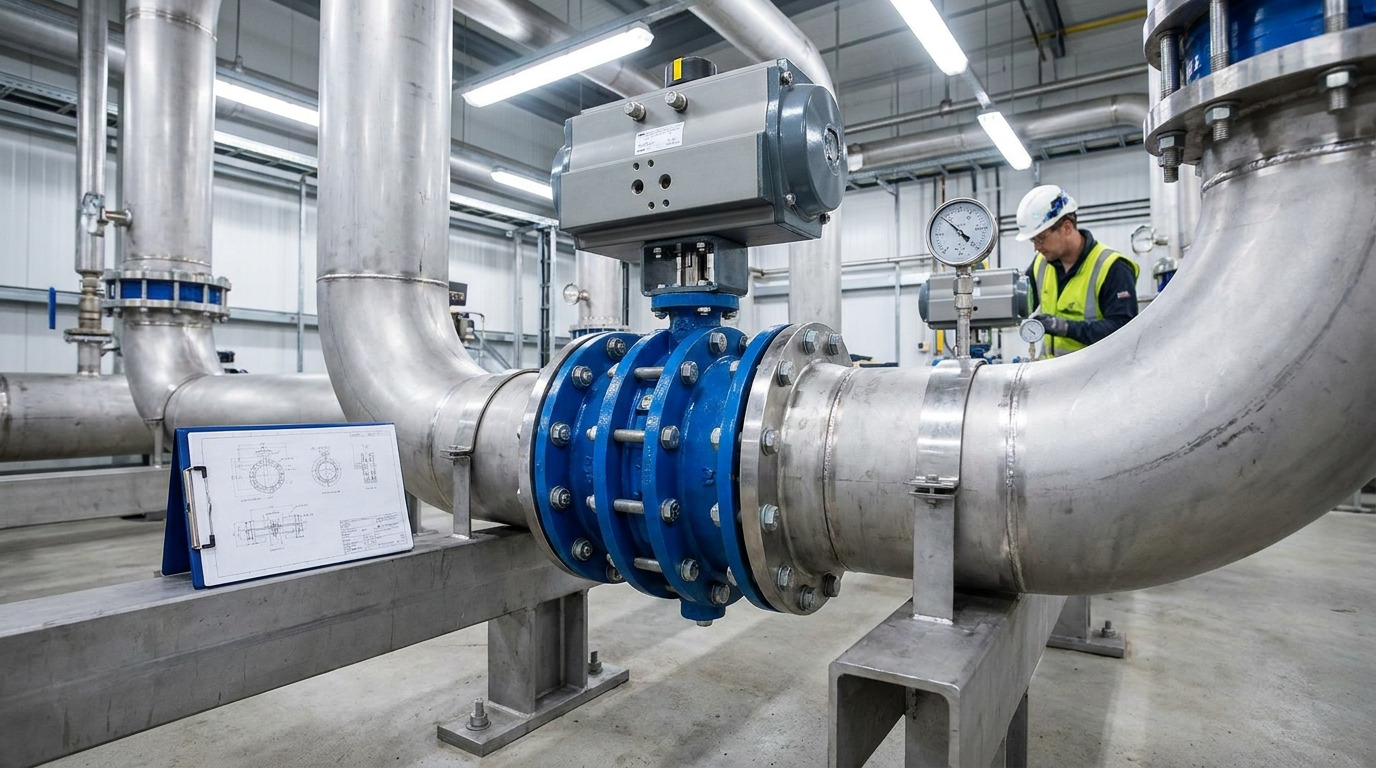
The main parts of a butterfly valve are the body, disc, stem, seat, seals, bearings, actuator, and connection hardware. Each component helps contain pressure, control flow, transfer torque, or prevent leakage.
A procurement team may receive a valve that matches pipe size yet fails during commissioning because its seat compound, stem design, or actuator torque does not match service conditions. That mismatch can cause leakage, delayed handover, and expensive replacement work. This guide explains the parts of a butterfly valve so you can compare specifications, evaluate suppliers, and order a dependable assembly.
What Are the Main Parts of a Butterfly Valve?
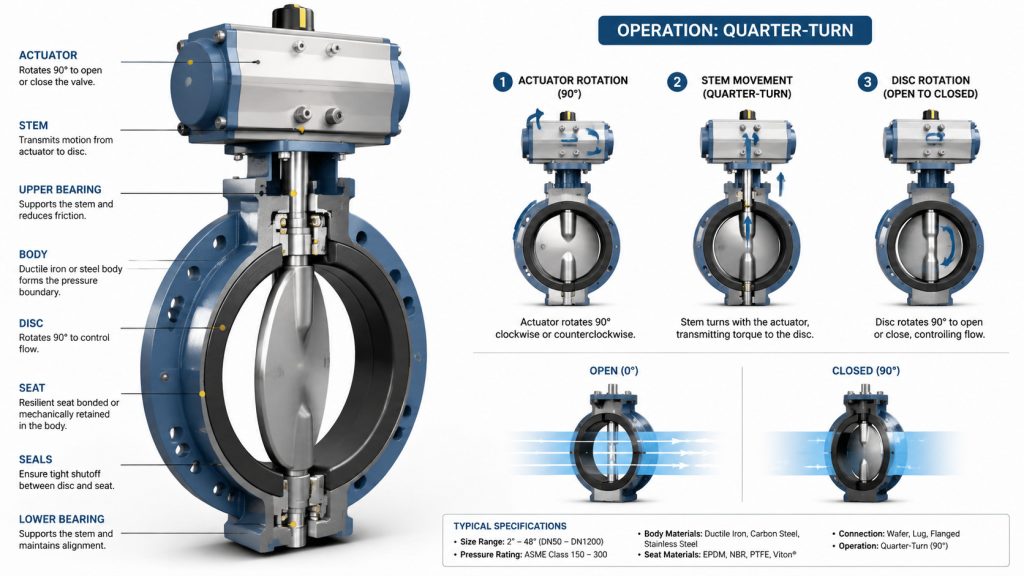
The main parts of a butterfly valve are the body, disc, stem, seat, seals, bearings, and operating mechanism. These components work as one quarter-turn assembly rather than as isolated items.
How Do These Components Work Together?
Here’s the practical point: an actuator turns the stem through 90 degrees, moving the disc across or parallel with flow. A seat seals against the disc edge while bearings support smooth shaft rotation.
- Body: contains pressure and connects with piping
- Disc: starts, stops, or regulates flow
- Stem: transfers operating torque
- Seat and seals: control internal and external leakage
- Actuator: provides manual or automated movement
| Component group | Main duty | Common risk |
|---|---|---|
| Pressure boundary | Contains media | Corrosion or cracking |
| Moving assembly | Controls flow | Wear or misalignment |
| Sealing system | Limits leakage | Chemical or thermal damage |
| Operator | Moves the disc | Insufficient torque |
This breakdown shows why one unsuitable component can weaken an otherwise sound valve.
Key Takeaway: You can prevent specification gaps by reviewing every component as part of one operating system.
How Does the Butterfly Valve Body Support the Assembly?
The parts of a butterfly valve rely on its body for pressure containment, flange alignment, and structural support. Body style also determines installation space, bolting arrangement, and whether downstream piping can be removed safely.
Which Body Style Fits Your Piping?
Wafer bodies sit between flanges, lug bodies use threaded lugs, and flanged bodies have integral connection faces. What matters here? Your choice must match pressure class, flange standard, maintenance plan, and dead-end requirements.
- Wafer: compact and economical for general service
- Lug: suitable for controlled single-side isolation
- Double-flanged: rigid support for large pipelines
- Welded or special ends: selected for uncommon interfaces
| Body style | Installation feature | Typical application |
|---|---|---|
| Wafer | Through-bolted between flanges | HVAC and water lines |
| Lug | Threaded bolt holes | Sectional maintenance |
| Flanged | Integral flange faces | Large or buried pipelines |
| Special end | Engineered connection | Custom process systems |
This comparison narrows suitable body designs before dimensional review begins.
Key Takeaway: You can reduce site modifications by confirming body pattern, flange drilling, and face-to-face dimensions before purchase.
How Does the Butterfly Valve Disc Control Flow?
The parts of a butterfly valve use the disc as their primary flow-control element. Its profile, position, edge finish, and material affect capacity, pressure loss, shutoff performance, and operating torque.
What Should You Check in a Disc?
A thin, streamlined disc offers lower resistance while a thicker design may provide greater strength. This is where details count: poor concentricity or a damaged edge can increase torque and prevent uniform seat contact.
- Verify disc material against fluid chemistry
- Check coating resistance against abrasion
- Confirm edge finish and dimensional accuracy
- Review clearance with adjacent pipe components
- Match disc geometry with throttling duty
| Disc feature | Performance effect | Review point |
|---|---|---|
| Profile | Flow capacity | Cv or Kv data |
| Edge finish | Seat contact | Surface condition |
| Material | Corrosion resistance | Media compatibility |
| Offset geometry | Friction and torque | Valve design type |
Disc geometry links hydraulic performance with sealing behavior.
Key Takeaway: You can avoid unstable control and premature seat wear by matching disc construction with flow velocity, media, and duty cycle.
What Does the Butterfly Valve Stem Do?
The linked parts of a butterfly valve depend on the stem to transmit actuator torque directly into disc movement. A correctly sized stem resists twisting, bending, fatigue, and corrosion throughout repeated operating cycles.
Which Stem Design Offers Reliable Torque Transfer?
One-piece stems provide continuous alignment while split stems can reduce flow obstruction and simplify certain assemblies. Here’s the catch: diameter alone does not prove strength because material grade, keyways, pin holes, and stress concentration also matter.
- One-piece shaft: continuous support and alignment
- Split stem: reduced obstruction around disc center
- Dry stem: isolated from process media
- Wetted stem: requires full chemical compatibility
- Blowout-resistant design: improves pressure safety
| Stem factor | Why it matters | Evidence to request |
|---|---|---|
| Material grade | Strength and corrosion resistance | Material certificate |
| Diameter | Torque capacity | Calculation or drawing |
| Connection | Disc torque transfer | Detail drawing |
| Retention | Blowout protection | Assembly record |
These checks reveal more than a basic material description can show.
Key Takeaway: You can limit stem failure by reviewing calculated torque, pressure load, material traceability, and retention design together.
How Does the Butterfly Valve Seat Prevent Leakage?
The parts of a butterfly valve use the seat to form a shutoff barrier against the disc edge. Seat material and geometry must suit fluid chemistry, temperature, pressure differential, and cycling frequency.
What Seat Material Should You Specify?
EPDM commonly serves water systems, NBR handles many oil-related duties, and PTFE offers broad chemical resistance. The deciding factor is simple: use verified compatibility data rather than choosing a compound from price alone.
- EPDM: water, dilute chemicals, and many HVAC duties
- NBR: oils, fuels, and compressed-air applications
- PTFE: corrosive media and wider temperature exposure
- FKM: selected chemical and higher-temperature duties
- Metal seat: steam, abrasive media, or severe heat
| Seat material | Typical strength | Main limitation |
|---|---|---|
| EPDM | Water resistance | Petroleum exposure |
| NBR | Oil resistance | Ozone and high heat |
| PTFE | Chemical resistance | Higher operating torque |
| Metal | Severe-service durability | Lower soft-seat tightness |
Material selection must follow actual concentration, temperature, and pressure rather than fluid name alone.
Key Takeaway: You can extend sealing life by giving suppliers complete operating conditions before approving a seat compound.
How Do Actuators Operate Butterfly Valve Components?
The parts of a butterfly valve receive controlled motion from a lever, gearbox, pneumatic actuator, electric actuator, or hydraulic operator. Operator selection depends on required torque, operating speed, control signal, environment, and fail position.
Which Operator Matches Your Duty?
Handles suit smaller valves with accessible locations while gearboxes reduce manual effort on larger sizes. Now consider this: automated operators must deliver enough seating torque under maximum differential pressure rather than only under workshop conditions.
- Lever: simple local operation
- Gearbox: controlled manual movement
- Pneumatic actuator: fast cycling and fail-safe options
- Electric actuator: remote positioning and feedback
- Hydraulic actuator: high force for demanding installations
| Operator | Strongest use | Specification check |
|---|---|---|
| Lever | Small manual valves | Handle clearance |
| Gearbox | Larger manual valves | Gear ratio |
| Pneumatic | Rapid automation | Air pressure |
| Electric | Remote control | Voltage and enclosure |
| Hydraulic | High-torque duty | Supply pressure |
Operator type affects control behavior, maintenance access, and emergency response.
Key Takeaway: You can prevent stalled movement by sizing from verified breakaway and seating torque with a suitable service margin.
Why Do Seals and Bearings Matter?
The parts of a butterfly valve use stem seals to block external leakage and bearings to guide shaft rotation. These smaller items influence fugitive emissions, operating torque, alignment, and long-term cycling reliability.
What Wear Components Need Close Review?
O-rings, packing, bushings, thrust washers, and gaskets must remain stable under pressure and temperature changes. A small detail makes a big difference: swollen seals or worn bushings can raise torque before visible leakage appears.
- Inspect packing for hardening or extrusion
- Check bushings for play and scoring
- Confirm elastomers against process media
- Review thrust surfaces for uneven loading
- Replace disturbed seals during major disassembly
| Wear item | Main function | Common symptom |
|---|---|---|
| Stem packing | External sealing | Leakage near operator |
| Bushing | Shaft guidance | Uneven movement |
| O-ring | Static sealing | Seepage |
| Thrust washer | Axial support | Disc misalignment |
Early torque changes often provide warning before a shutdown event develops.
Key Takeaway: You can plan maintenance sooner by tracking operating torque, stem play, and visible seal condition during routine inspections.
How Do Connection Parts Affect Installation?
The linked parts of a butterfly valve depend on compatible flanges, bolts, gaskets, and pipe alignment for safe installation. Incorrect hardware can distort the body, damage the seat, or block disc travel.
What Should Installers Verify Before Bolting?
Flanges should remain parallel, clean, and spaced without forcing the valve into position. Before tightening anything: center the valve, open the disc slightly, and confirm that nearby pipework will not interfere with rotation.
- Match flange drilling with valve standard
- Use specified bolt grade and length
- Tighten bolts gradually in a cross pattern
- Support piping without loading the valve body
- Check disc clearance before full operation
| Installation item | Required check | Failure risk |
|---|---|---|
| Flanges | Parallel alignment | Body distortion |
| Bolts | Correct grade and length | Joint movement |
| Gaskets | Manufacturer approval | Seat interference |
| Pipe bore | Disc clearance | Disc damage |
Proper alignment protects both pressure boundary and moving assembly.
Key Takeaway: You can prevent commissioning leaks by checking interfaces before applying final bolt torque.
How Should Butterfly Valve Materials Be Selected?
The parts of a butterfly valve need materials that tolerate process chemistry, temperature, pressure, velocity, and suspended solids. Each wetted component may require a different alloy, coating, or polymer.
Which Material Combinations Suit Common Services?
Ductile iron often serves water networks while stainless steel supports corrosive or hygienic duties. Here’s what changes the answer: chloride level, cleaning chemicals, temperature cycling, and abrasion can rule out an otherwise familiar material.
- Ductile iron body with EPDM seat for treated water
- Stainless disc with PTFE seat for chemical service
- Aluminum-bronze disc for selected seawater systems
- Coated disc for mildly abrasive water
- Metal seat and alloy body for hot service
| Service | Common body | Common trim |
|---|---|---|
| Potable water | Coated ductile iron | Stainless disc, EPDM |
| Oil service | Carbon steel | Stainless disc, NBR |
| Chemicals | Stainless steel | PTFE or alloy trim |
| Steam | Carbon or alloy steel | Metal seat |
A complete material schedule makes supplier quotations easier to compare.
Key Takeaway: You can reduce corrosion and seal damage by specifying every wetted material rather than body material alone.
How Can You Verify Every Component Before Purchase?
The linked parts of a butterfly valve should be checked against drawings, datasheets, certificates, and test records before shipment. A structured review confirms dimensions, materials, torque, leakage performance, and documentation.
What Should Your Inspection Checklist Include?
Start with nameplate data and traceability before reviewing assembly alignment and pressure-test results. Here’s the useful part: a short approval checklist can stop mismatched components before they reach your site.
- Compare valve data with purchase specifications
- Check material certificates against heat numbers
- Review shell and seat leakage results
- Confirm actuator settings and travel stops
- Inspect coating, markings, and packaging
- Request dimensional and torque records
| Record | Confirms | Procurement value |
|---|---|---|
| Approved drawing | Dimensions and configuration | Fit verification |
| Material certificate | Grade and traceability | Compliance review |
| Pressure report | Shell and seat performance | Quality evidence |
| Torque record | Operating behavior | Actuator validation |
Document alignment makes technical approval faster and more defensible.
Key Takeaway: You can lower delivery risk by defining required inspection records within the purchase order.
Ready to Specify the Right Valve Assembly?
You now have a practical framework for identifying butterfly valve components, comparing body and disc designs, selecting stems and seats, sizing operators, checking materials, and reviewing inspection evidence. If you need application-specific guidance, contact us today with your media, size, pressure, temperature, connection standard, and operating method.
Our team can help you prepare a clear valve specification, review component compatibility, and build a documented supply package for your project. Reliable flow control begins with components engineered as one system—and that principle guides every valve solution we support.
Frequently Asked Questions
Can I replace only the seat in a butterfly valve?
Yes, if the valve uses a replaceable seat and other components remain within tolerance. Check disc edges, stem alignment, body condition, and manufacturer instructions before reassembly.
What’s the best butterfly valve seat for water service?
EPDM usually suits clean water and many HVAC systems. Temperature, disinfectant concentration, pressure, and potable-water approvals should still guide your final choice.
How do I know if a butterfly valve stem is damaged?
Look for excessive operating torque, shaft play, irregular disc movement, packing leakage, or visible deformation. A dimensional inspection can confirm wear or twisting.
Can I use a wafer butterfly valve for dead-end service?
Usually not unless its manufacturer specifically rates that design for such duty. Lug or flanged bodies generally provide a more suitable connection arrangement.
What’s the best actuator for a large butterfly valve?
A gearbox often suits occasional manual operation while electric, pneumatic, or hydraulic actuators fit automated duty. Required torque, cycling rate, control needs, and available power determine the right option.