
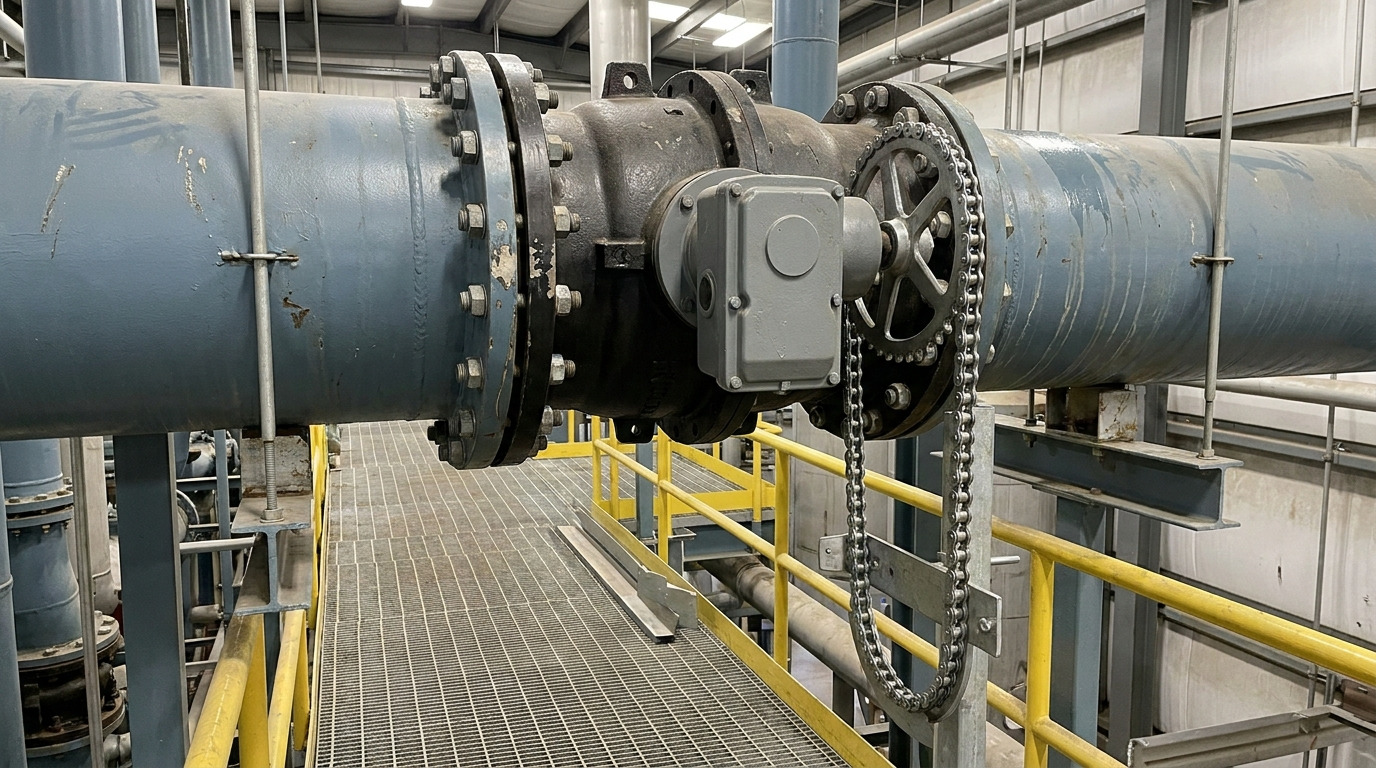
You should use a chain operated butterfly valve when the valve must stay manually operated but the handwheel is mounted where direct hand access would be unsafe, awkward, or impractical. In that setup, the chain operated butterfly valve uses a looped chain and gear operator to turn the disc through its quarter-turn travel without adding electric or pneumatic actuation.
A typical case is an overhead cooling-water, wastewater, or utility line running above a walkway or platform. The valve still needs occasional isolation, but climbing to reach a handwheel creates more risk than the valve itself. A chain operator solves that access problem only when the valve torque, chain drop, mounting space, and service conditions all make sense.
What a Chain Operated Butterfly Valve Actually Does
A chain operator adds remote manual access to a butterfly valve; it does not change the basic flow-control principle. The valve is still a quarter-turn valve, meaning the disc normally rotates about 90 degrees from fully closed to fully open, while the chain and gearbox only change how the operator applies torque.
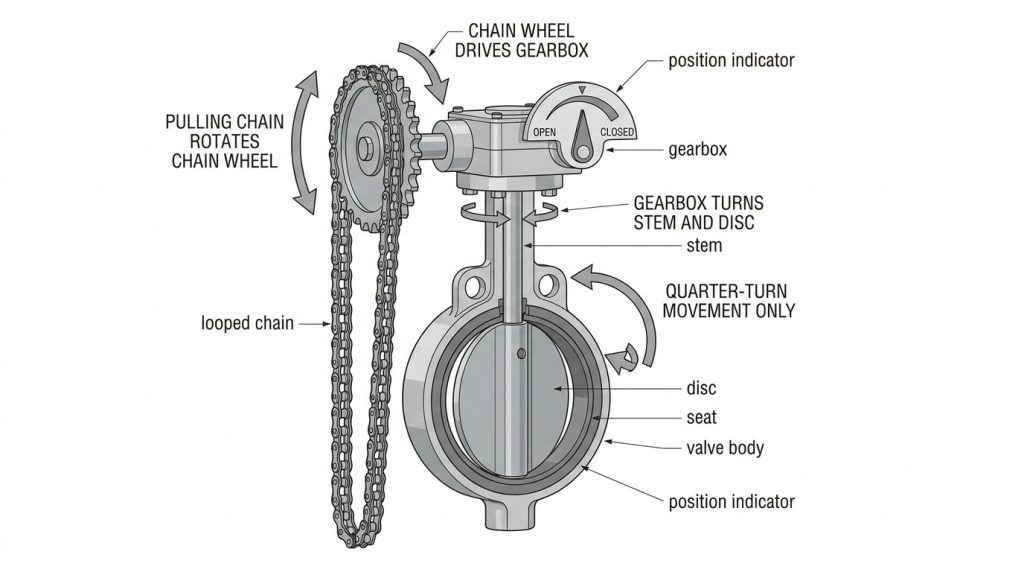
If you already understand the basic butterfly valve structure, the chain version is easier to judge. Think of it as a manual valve package: valve body, disc, stem, seat, gearbox, chain wheel, looped chain, and position indication all working together.
How Does the Chain Turn the Disc?
The operator pulls one side of the chain loop, which rotates the chain wheel mounted on the gearbox handwheel or input shaft. The gearbox reduces speed and multiplies torque, then turns the valve stem and disc.
This matters because the chain does not directly “pull the disc open.” It turns a mechanical drive. If the gearbox ratio, stem torque, or chain-wheel fit is wrong, the valve may feel heavy, stop short of full travel, or encourage operators to pull harder than the valve was designed to handle.
What Parts Are Added to a Normal Butterfly Valve?
The added parts are usually a chain wheel, chain guide, looped chain, attachment hardware, and a gear operator suitable for quarter-turn service. Many cataloged chain-wheel operators are selected by the gearbox handwheel outside diameter, with common catalog ranges covering about 2 to 36 in handwheels, depending on the chain-wheel manufacturer.
That range is not the same as valve size. A 12 in valve and a 24 in valve may use different gearboxes, handwheels, and torque ratings, so the chain operator must be matched to the actual operator package rather than guessed from pipe size alone.
When Chain Operation Is the Right Manual Choice
Chain operation is the right choice when you need occasional manual operation from a safer position, not continuous modulation or automated control. It is most useful for overhead lines, valve pits, pipe racks, utility headers, and areas where a normal lever or handwheel would force the operator into an awkward position.
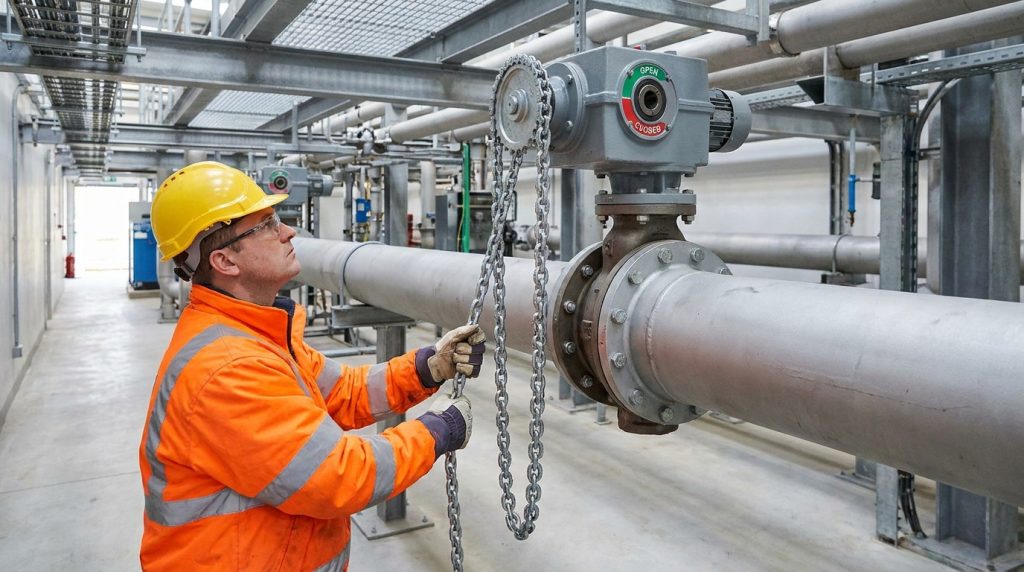
It is not automatically the best answer for every hard-to-reach valve. If the valve must cycle frequently, respond to a control signal, close quickly during process trips, or report position to a control room, a pneumatic or electric actuator may be the better solution.
Can You Reach the Valve Safely by Hand?
If the operator needs a ladder, has to lean across equipment, or cannot see the valve position clearly, chain operation may reduce access risk. The chain loop should hang where the operator can pull vertically without blocking a walkway, rubbing on nearby pipework, or creating a snag point.
The important question is not only “can the chain reach the floor?” It is whether the operator can stand in a stable position, see or verify the open/closed status, and pull the chain without side-loading the gearbox.
Would an Actuator Be More Appropriate?
Use a chain operator when the valve is manual, low-frequency, and local operation is acceptable. Use an actuator when the process requires remote signals, interlocks, fast response, regular throttling, or position feedback.
A chain wheel often works well when a butterfly valve with gearbox already needs torque reduction because of size, pressure, or seat design. If you are adding a chain because the valve is hard to turn, however, stop and check the torque cause first. A stiff valve may indicate poor alignment, wrong seat material, debris, or damage rather than a need for a longer chain.
Specifications to Confirm Before You Approve It
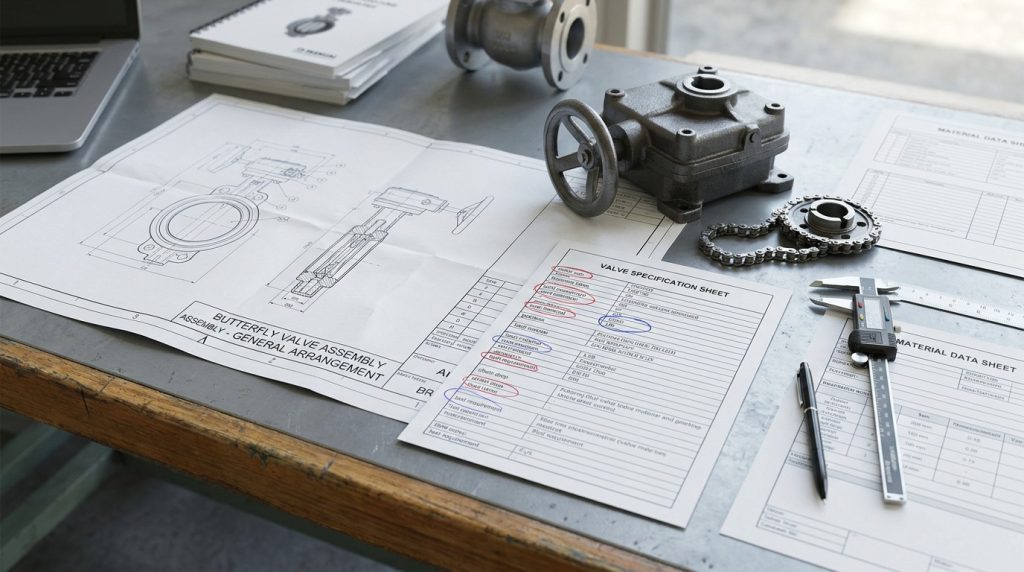
The most important specifications are the valve standard, size, pressure class, end connection, seat material, gearbox torque, chain-wheel fit, chain length, and test requirement. A chain operated butterfly valve is still a pressure-containing valve first and an access device second.
If your project names an API 609 butterfly valve, treat that as a valve design and inspection framework, not as a complete chain-wheel specification. API 609 covers butterfly valve design items such as materials, face-to-face dimensions, pressure-temperature ratings, examination, inspection, and testing for applicable double-flanged, lug, wafer, and butt-welding-end designs.
Use this table to separate the valve requirements from the chain-operation requirements before you approve a drawing or quotation.
| Specification item | What to confirm | Practical boundary |
|---|---|---|
| Valve travel | Disc rotation and stops | Butterfly valves are normally 0 to 90 degree quarter-turn valves |
| Chain-wheel fit | Gearbox handwheel OD or input design | Many chain-wheel catalogs cover about 2 to 36 in handwheel OD ranges |
| Valve design standard | API 609, MSS SP-67-2022, EN 593, or project standard | MSS SP-67-2022 covers butterfly valves including NPS 1-1/2 through NPS 72 within its stated scope |
| Mounting interface | Gearbox-to-valve mounting and drive | ISO 5211 applies to part-turn actuator attachments, with or without gearboxes |
| Pressure testing | Shell and seat test basis | API 598, ISO 5208, or EN 12266 should be named where applicable |
| Seat material | Media and temperature compatibility | Typical soft-seat ranges must be confirmed by the valve data sheet |
The key point is simple: do not approve a chain wheel as a loose accessory if the gearbox, valve torque, and test standard have not been checked together. The final values for torque, chain length, pressure-temperature rating, and seat limits must come from the valve drawing or data sheet for the exact configuration.
Which Size, Class, and End Connection Matter?
Size affects torque, but it does not decide everything. A small high-performance valve with a tight seat can require more operating torque than a larger low-pressure resilient-seated valve in clean water service.
Pressure class also needs careful reading. Class 150, Class 300, PN10, or PN16 are rating systems tied to material and temperature conditions, not simple universal working-pressure numbers. End connection matters as well: wafer valves depend on flange clamping, lug valves may support more installation options, and flanged valves add body length and bolting weight.
What Should Be Checked on the Chain Operator?
Check the chain-wheel material, chain material, chain guide, attachment method, chain loop length, handwheel fit, travel stops, and position indicator. For outdoor, marine, chemical, or washdown areas, chain and attachment corrosion resistance can matter as much as valve body material.
Also confirm whether the chain wheel is factory installed or field installed. Factory installation reduces mismatch risk, while field installation needs careful inspection of clamp security, clearance, and chain alignment.
Material and Service Limits That Change the Decision
Material limits decide whether the valve will seal smoothly or become a maintenance problem. The chain operator may make the valve easier to reach, but it cannot compensate for a seat, disc, or body material that is wrong for the fluid.
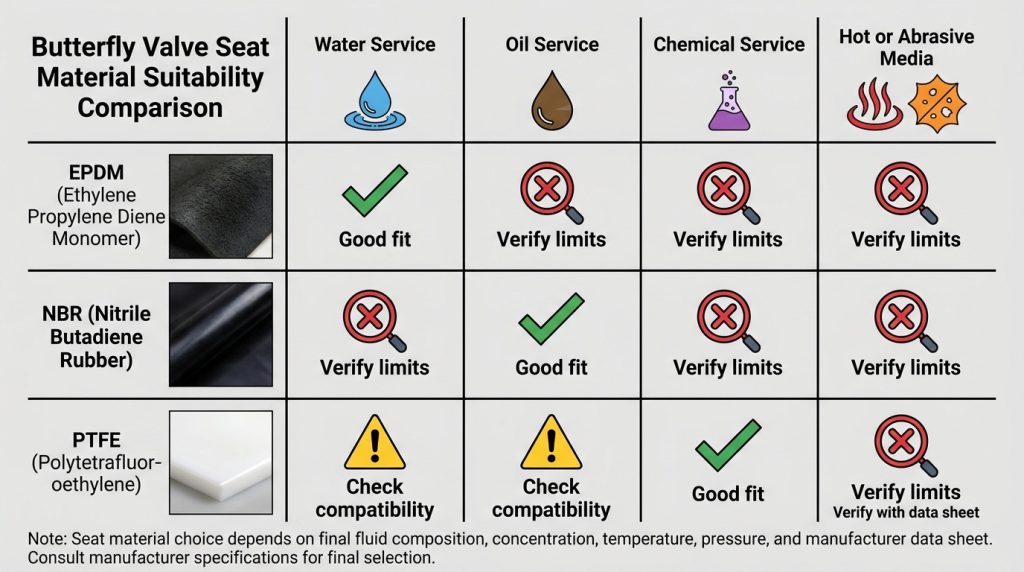
For soft-seated butterfly valves, the seat is often the limiting component. Typical manufacturer data-sheet ranges are about -20 to 120 C for many EPDM water-service seats, about -10 to 100 C for many NBR oil-compatible seats, and about -20 to 180 C for many PTFE-lined or PTFE-seat designs. These are practical starting ranges, not universal limits, because formulation, pressure, cycling frequency, and chemical concentration change the final rating.
How Do Seat Materials Change the Limits?
EPDM is commonly considered for water, wastewater, cooling water, and some dilute chemical services, but it is usually a poor choice for petroleum oils and many hydrocarbons. NBR is often considered where oil compatibility is needed, but it is less suitable for ozone, some solvents, and higher-temperature service.
PTFE can improve chemical resistance and temperature capability, but it may increase cost and can change torque behavior. When the fluid is aggressive, hot, dirty, or abrasive, check butterfly valve material limits before you focus on the chain operator.
What Media or Temperature Should Make You Pause?
Pause when the line carries steam, abrasive slurry, crystallizing chemicals, sticky media, dry bulk solids, or fluids that can harden around the disc. A chain operator may let you pull from a distance, but it does not protect the seat from swelling, abrasion, thermal damage, or buildup.
You should also pause when the valve is expected to throttle for long periods. Butterfly valves can control flow in intermediate positions, but a chain operator gives coarse manual positioning. If stable flow control matters, the discussion should move toward actuator selection and control characteristics.
Common Misreads That Lead to Bad Operation
Most poor chain operated butterfly valve decisions come from treating the chain as a simple convenience accessory. In practice, chain length, pull direction, gearbox sizing, operator visibility, and valve torque all affect whether the valve feels controlled or troublesome.
The common mistakes are easy to avoid if you check the complete operating path:
- Selecting the chain wheel by valve size instead of gearbox handwheel size
- Assuming a longer chain always makes operation easier
- Ignoring chain swing near walkways, instruments, insulation, or hot surfaces
- Adding a chain operator to a valve that is already stiff for mechanical reasons
- Forgetting that the operator still needs clear open/closed indication
- Specifying “zero leakage” without naming the applicable seat test standard
- Using a chain operator where remote control or feedback is actually required
Is More Chain Always Better?
No, more chain is not always better. A chain loop that is too long can drag, tangle, swing into nearby equipment, or make the pull angle poor.
The right chain length lets the operator stand safely and pull with a clean vertical motion. If the valve is far above the normal operating level, consider whether a stem extension, remote gearbox, platform change, or actuator is the better engineering answer.
Can a Chain Operator Be Added Later?
It can often be added later, but only if the existing valve and gearbox can accept it safely. You need to confirm the handwheel outside diameter, mounting clearance, gearbox condition, travel stops, and available space around the chain loop.
This is where basic field dimensions matter. Before retrofitting, confirm valve size, face-to-face space, flange pattern, and operator envelope using the same discipline you would apply when checking butterfly valve sizes for replacement. A chain wheel that fits the handwheel but clashes with piping or insulation is not a workable solution.
How to Specify It Without Overcomplicating the Valve
A good specification gives enough detail to prevent mismatch without turning a simple manual valve into a custom-engineering project. Start with the valve duty, then add the operator conditions.
For a practical request, include these items:
- Valve size and pipe standard
- Pressure class or PN rating
- Wafer, lug, or flanged body style
- Body, disc, stem, and seat material
- Fluid, concentration, temperature, and pressure
- Required design and test standards
- Gearbox type and required position indication
- Chain material and chain loop drop
- Indoor, outdoor, corrosive, marine, or washdown environment
- Any drawing limits for clearance around the operator
From a valve manufacturer’s perspective, the most useful detail is the operating condition, not just the product name. “DN300 PN16 EPDM seated lug butterfly valve with chain wheel” is a start, but it still leaves open questions about fluid, temperature, flange standard, torque, test requirement, and chain drop.
Do not over-specify the chain before the valve is confirmed. If the valve material or seat is wrong, the operator choice cannot rescue the application. Confirm the valve first, then match the gearbox and chain operator to that valve.
Conclusion
A chain operated butterfly valve is a practical choice when you need safe, occasional manual operation for a hard-to-reach butterfly valve. The real decision is not whether a chain can be attached, but whether the valve torque, gearbox, chain-wheel fit, seat material, end connection, pressure class, and test standard all support reliable operation in your service conditions.
If you are comparing a new valve package or checking whether a chain operator fits an existing installation, prepare the fluid, pressure, temperature, valve size, flange standard, material preference, operator height, and any project drawing limits, then share your valve requirements for a focused specification discussion.
FAQ
Can I Use a Chain Operated Butterfly Valve Outdoors?
Yes, if the valve and operator materials are suitable for the environment. Outdoor service needs attention to corrosion, rainwater, dust, UV exposure, and chain material. Galvanized or stainless chain options may be considered depending on the site conditions, but the final choice should match the valve data sheet and project corrosion requirements.
What’s the Best Seat Material for This Valve Type?
The best seat material is the one that matches the fluid and temperature, not the chain operator. EPDM is commonly used for water-type services, NBR is often used where oil compatibility is needed, and PTFE is considered for stronger chemical resistance. The final selection must be checked against the actual media concentration, temperature, pressure, and cycling frequency.
How Do I Know if Chain Operation Is Better Than a Lever?
Choose chain operation when the valve is too high, too low, or awkward for direct lever use. A lever works for accessible smaller valves where the operator can stand safely beside the valve. A chain operator is better for overhead or difficult access, especially when a gearbox is already needed for controlled torque.
Can I Add a Chain Wheel to Any Butterfly Valve?
No, not every butterfly valve is a good candidate. The valve normally needs a suitable gear operator or compatible handwheel arrangement, enough clearance, correct travel stops, and acceptable operating torque. If the valve is stiff, damaged, or misaligned, adding a chain wheel may hide the real problem rather than solve it.
What Should I Check Before Ordering One?
Check the valve size, pressure class, end connection, material, seat, media, temperature, gearbox torque, handwheel diameter, chain length, chain material, and required test standard. Also confirm whether the valve will be factory assembled with the chain operator. That reduces the risk of a chain wheel fitting the handwheel but failing the real installation conditions.