
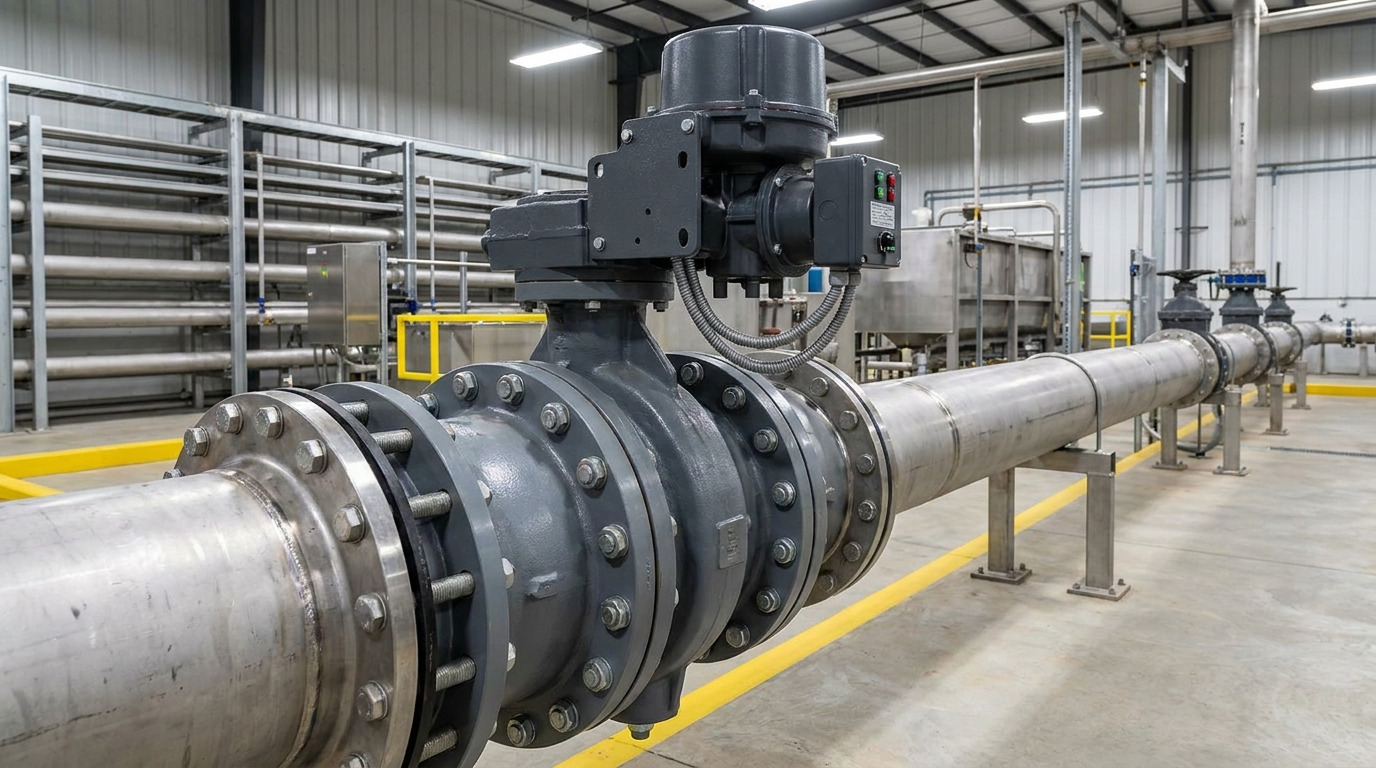
A butterfly valve is a compact, quarter-turn rotational motion valve used in pipelines to isolate, regulate, or shut off the flow of a process medium via a rotating disc. Traditional multi-turn valves often suffer from sluggish actuation, heavy physical footprints, and high installation costs. These oversized structures increase pipe loads and cycle slowly, risking devastating water hammer and line leakage. Utilizing what is butterfly valve mechanics provides a lightweight, rapid quarter-turn isolation solution that minimizes long-term maintenance.
What Is Butterfly Valve Design and Core Purpose?
The design of this equipment serves to manage, control, and halt fluid flow instantly within compact spatial limits. When analyzing what is butterfly valve technology, you see a flat disc rotating 90 degrees to block lines.
Why Choose a Quarter-Turn Design?
Let’s face it: slow-closing valves delay system isolation during emergency pipeline shutdowns. A 90-degree quarter-turn mechanism provides rapid, dependable closure to prevent dangerous backflow.
This design offers significant physical pipeline benefits:
- Rapid cycle speeds for immediate shutoff.
- Minimized physical effort during manual operations.
Key Takeaway: Quarter-turn rotation ensures fast pipeline isolation, protecting valuable downstream equipment.
| Mode | Angle | Seat Wear |
|---|---|---|
| Isolation | 0° or 90° | Low |
| Throttling | 15° to 75° | High |
This distinct operational mode directly influences the choice of internal component layouts.
What Is Butterfly Valve Internal Component Layout?
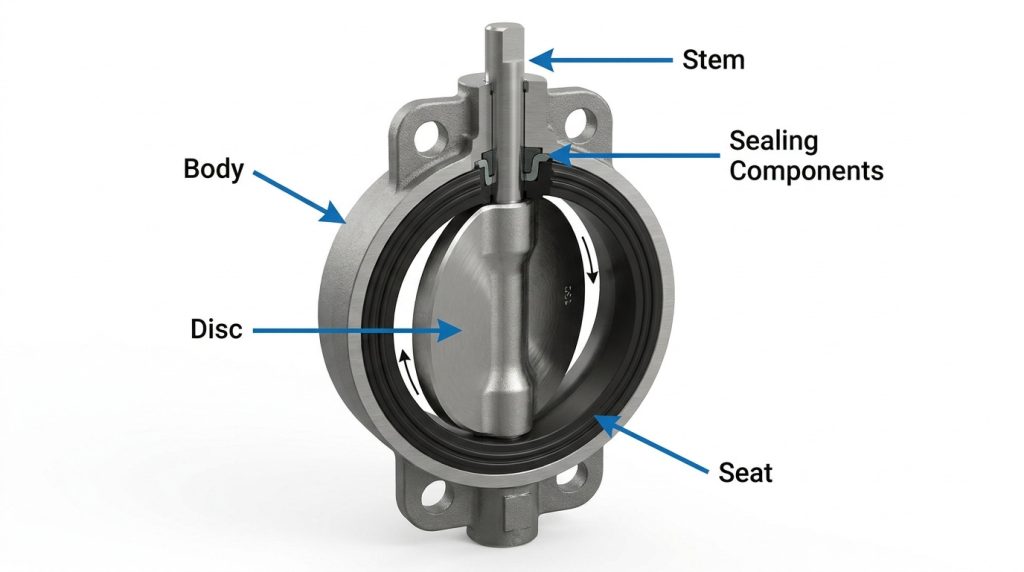
The internal layout of this system consists of a centralized disc, a sealing seat, a driving stem, and protective body housing. Analyzing what is butterfly valve anatomy helps you choose a double-eccentric butterfly valve to secure high-pressure water systems.
How Do Internal Parts Prevent Leakage?
Here is the deal: even minor component misalignments cause fluid to leak past primary seals. The disc seals tightly against the resilient seat, while O-rings isolate the driving stem.
These components are optimized for performance:
- Stem bushings prevent shaft deflection.
- Epoxy coatings protect ductile iron bodies.
Key Takeaway: Precision-aligned internals distribute physical pipeline loads evenly to protect delicate seating seals.
| Component | Function | Material |
|---|---|---|
| Disc / Shaft | Controls flow | Stainless Steel |
| Seat & Seals | Tight shutoff | EPDM, Viton |
This internal design profile dictates the efficiency of the valve’s overall operating cycle.
How Does What Is Butterfly Valve Operating Cycle Work?
The operating cycle functions by rotating the internal disc 90 degrees to block, throttle, or permit the movement of media. When you examine what is butterfly valve cycle mechanics, you find that the disc remains positioned directly in the flow stream.
How Does the Disc Control Flow?
Think about it: how does a simple disc manage pressurized flow without causing severe friction? Turning the actuator rotates the disc from parallel to perpendicular alignment to halt fluid.
This movement creates distinct hydraulic conditions:
- Fully Open (90°) creates minimal line restriction.
- Fully Closed (0°) provides bubble-tight flow isolation.
Key Takeaway: The 90-degree operating cycle provides immediate flow control but keeps the disc in-stream.
| Angle | Flow Rate | Pressure Drop |
|---|---|---|
| 0° (Closed) | 0% | Maximum |
| 90° (Open) | 100% | Minimum |
This rotational movement must be supported by correct pipeline connection types to prevent external leaks.
How to Select What Is Butterfly Valve Connection Types?
Selecting the correct connection type involves evaluating your system’s pressure, maintenance access, and structural piping stress. When assessing what is butterfly valve mounting, choosing between concentric vs double-eccentric butterfly valves helps determine the appropriate connection interface.
Which Body Connection Style Fits Your Pipe?
But wait, there’s more: choosing an incorrect flange mating style causes structural pipe leaks. Wafer styles clamp between flanges, whereas lug styles utilize threaded inserts to allow single-sided maintenance.
These connection designs are selected based on maintenance and pressure limits:
- Wafer types offer low-cost installation.
- Lug types permit downstream pipe servicing.
Key Takeaway: Matching connections to pipeline stresses prevents mechanical failure and simplifies future maintenance.
| Type | Bolt Style | Dead-End Service |
|---|---|---|
| Wafer | Through-bolts | No |
| Lug | Threaded bolts | Yes |
Beyond flange connections, eccentric seat offset designs directly impact long-term seal reliability.
What Is Butterfly Valve Disc Offsets and Seat Designs?
Disc offsets and seat designs refer to the physical displacement of the stem from the disc centerline to reduce friction. In standard applications, understanding what is butterfly valve offset geometry helps engineers choose between zero, double, and triple offset units.
Why Do Eccentric Offsets Reduce Wear?
The best part? Standard concentric valves experience friction throughout their entire 90-degree travel path. Eccentric offset designs use a cam-action mechanism that lifts the disc off the seat immediately upon opening.
These geometries extend seal life and reduce maintenance:
- Double offsets eliminate continuous seat friction.
- Metal seats handle high-temperature industrial pipelines.
Key Takeaway: Eccentric offset geometries eliminate continuous seat friction to prolong the valve’s sealing lifespan.
| Offset | Stem Position | Main Benefit |
|---|---|---|
| Double | Dual centerline offset | No seal friction |
| Triple | Angled sealing plane | Metal-to-metal seal |
These advanced offsets make butterfly valves highly competitive when compared directly to traditional gate valves.
Why Compare What Is Butterfly Valve vs Gate Valves?
Comparing these designs reveals major differences in installation space, physical weight, and long-term operating costs. When deciding what is butterfly valve vs gate valve utility, you can integrate a resilient-seated butterfly valve to save space and budget.
Which Valve Style Offers More Efficiency?
Think about it: gate valves require massive vertical bonnets and multi-turn handwheels to operate. Butterfly valves utilize compact bodies that reduce raw material usage, lowering shipping and physical pipeline support costs.
These differences yield direct cost savings for plants:
- Up to 60% lighter than equivalent gate valves.
- Extremely short face-to-face dimensions to save installation space.
Key Takeaway: Choosing butterfly designs over gate valves slashes installation weight and structural piping support costs.
| Feature | Butterfly Valve | Gate Valve |
|---|---|---|
| Weight | Extremely Light | Heavy |
| Operation | Quarter-turn | Multi-turn |
Achieving these physical efficiencies also requires precise sizing to prevent downstream pressure drops.
What Is Butterfly Valve Sizing and Flow Coefficient?
Valve sizing and flow coefficient calculations are used to determine the exact fluid capacity a valve can handle without pressure loss. Calculating what is butterfly valve capacity ensures that your pipes operate without excessive restriction or velocity spikes.
How to Avoid Cavitation Risks?
Think about it: severe pressure drops across an incorrectly sized valve create vapor bubbles that collapse violently. This collapse causes rapid metal erosion and ruins the disc’s tight-sealing capability.
Proper sizing protects your pipeline from high velocities:
- Match internal diameters to optimize fluid velocity.
- Verify flow coefficient ($C_v$) to prevent pressure drops.
Key Takeaway: Calculating accurate flow coefficients prevents cavitation and extends internal valve components’ working life.
| Sizing | Pressure Drop | Cavitation Risk |
|---|---|---|
| Undersized | High | Very High |
| Correct | Minimal | Low |
Once the valve is sized properly, you can choose the ideal actuation method for automation.
How Does What Is Butterfly Valve Actuation Operate?
Actuation operates by applying manual, pneumatic, electric, or hydraulic rotational force to turn the valve stem. When determining what is butterfly valve actuation needs, you must assess the required torque and response time of your pipeline.
Should You Automate Your Pipeline Flow?
Let’s face it: manually turning large-diameter valves in remote locations is slow and inefficient. Automating your valves allows you to adjust flow rates instantly from a centralized control room.
Select the actuator that fits your system parameters:
- Pneumatic actuators offer high-speed fail-safe operations.
- Electric systems provide precise control and remote SCADA feedback.
Key Takeaway: Integrating automated actuation improves system response times and enhances overall operational safety.
| Actuation | Response Speed | Best Application |
|---|---|---|
| Pneumatic | Extremely Fast | High-cycle loops |
| Electric | Modulating | SCADA networks |
Alongside correct automation, internal metallurgies must be matched carefully to the pipeline’s media.
What Is Butterfly Valve Material Selection for Media?
Material selection involves choosing compatible metals and elastomers for the body, disc, and seals to resist chemical attack. Identifying what is butterfly valve metallurgy is crucial when handling aggressive media like salt water, sludge, or chemicals.
How Do Materials Prevent Corrosion?
But wait, there’s more: using incompatible elastomers leads to rapid swelling, seal tearing, and catastrophic leaks. Matching high-grade metals with chemical-resistant seat materials prevents galvanic corrosion and fluid contamination.
Always select materials suited to your specific media:
- EPDM seats work perfectly for drinking water.
- Duplex stainless steel prevents pitting in saline environments.
Key Takeaway: Tailored material selection prevents chemical degradation, maintaining tight sealing performance over decades.
| Media | Body / Disc Material | Seat Material |
|---|---|---|
| Potable Water | Epoxy Ductile Iron | EPDM |
| Chemicals | Stainless Steel | Viton / PTFE |
Even with optimized materials, routine maintenance remains vital for ensuring continuous operational reliability.
What Is Butterfly Valve Maintenance and Troubleshooting?
Maintenance and troubleshooting involve inspecting seals, verifying stem lubrication, and replacing worn components over time. Understanding what is butterfly valve maintenance routines helps you prevent unexpected pipeline shutdowns.
How to Extend Seat Operating Life?
The best part? These valves feature extremely simple internal layouts, making parts replacement fast and straightforward. Routinely cycling the valve clears away mineral scaling and prevents debris damage.
Simple actions prevent unexpected process shutdowns:
- Inspect shaft packing regularly for external seepage.
- Lubricate manual gears to ensure smooth manual operation.
Key Takeaway: Consistent preventative maintenance protects seal integrity and prevents unplanned pipeline downtime.
| Issue | Potential Cause | Solution |
|---|---|---|
| Internal Leak | Seat wear or scaling | Cycle valve or replace seat |
| Stem Seepage | Damaged O-rings | Replace shaft seals |
Investing in these simple practices guarantees that your system’s fluid control infrastructure performs reliably.
Secure Your Pipeline Systems with Trusted Engineering Partners
Managing large-diameter flow systems shouldn’t involve dealing with constant leakage, heavy piping stress, or massive structural footprints. By implementing precision-engineered quarter-turn valve solutions, your project can achieve reliable isolation, reduced weight, and minimal maintenance overhead. Our mission is to supply robust flow control systems that empower municipal water networks and industrial pipelines to operate with maximum efficiency and zero-leakage security. If you are ready to upgrade your pipeline parameters and review technical datasheets, contact us today to receive a custom engineered quote tailored to your exact project requirements.
FAQ
Can I use a butterfly valve for high-temperature steam lines?
Yes, you can. However, standard resilient-seated designs degrade quickly under extreme heat. For high-temperature steam, you must select triple-offset metal-seated configurations. These advanced designs use robust alloys that maintain tight sealing capabilities in extreme thermal environments.
What’s the best way to prevent water hammer when using these valves?
The best way is to slow down the valve closure speed. Slowing down the closure prevents sudden pressure surges. Installing manual worm gearboxes or programmable electric actuators ensures gradual closing.
How do I know if a wafer valve is better than a lug style?
You can decide by checking if you need dead-end piping isolation. Wafer styles clamp between flanges and are more economical. Lug styles feature threaded bolt inserts that let you service downstream pipe safely.
Can I mount a butterfly valve in a vertical pipeline?
Yes, you can. These valves function perfectly in any orientation. If vertical lines carry suspended solids, place the shaft horizontally to prevent debris from settling in the bottom bearings.
How do I know if my valve seat needs to be replaced?
You will know when you observe consistent through-line leakage. If the valve leaks when fully closed, the seal is worn or torn. You must install a replacement seat to restore bubble-tight shutoff.