
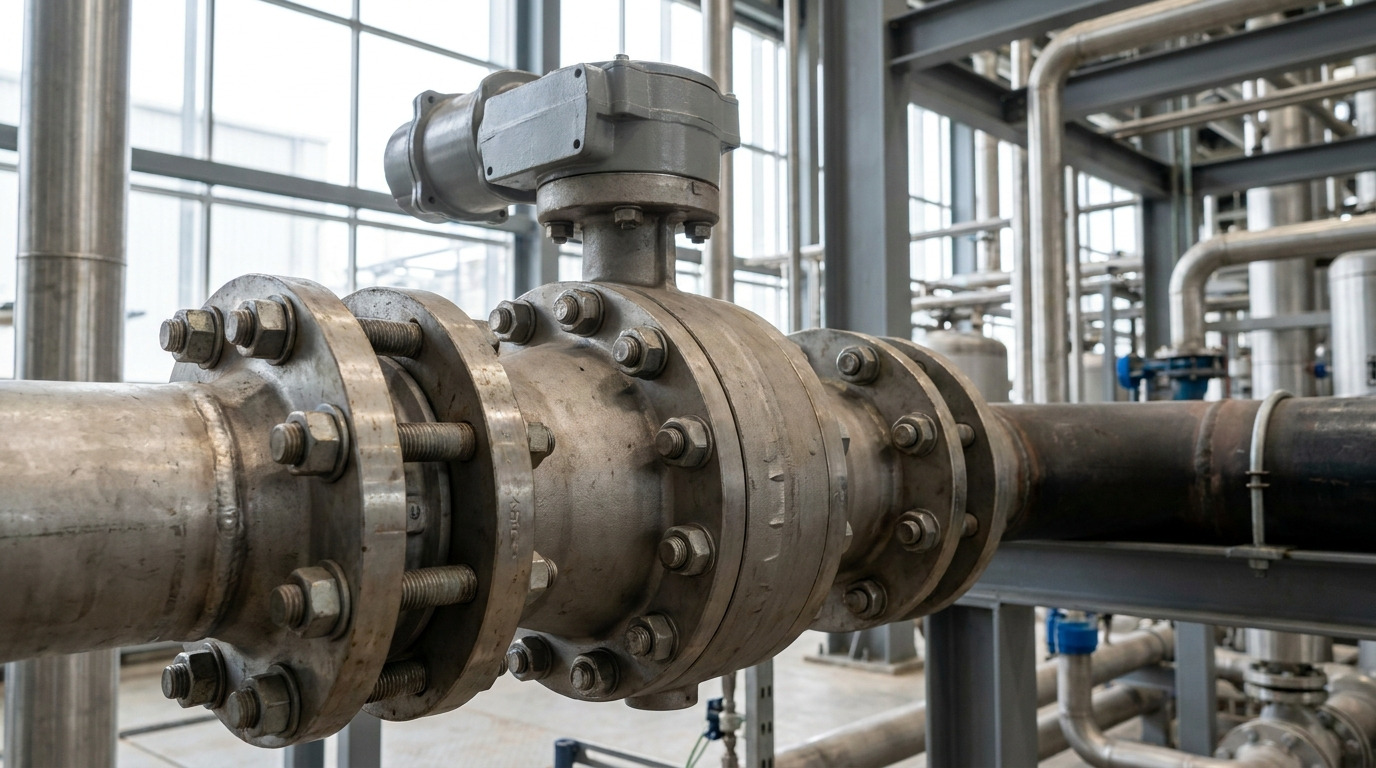
Selecting and installing the correct fasteners using a standardized butterfly valve bolt chart is the ultimate way to ensure a leak-free pipeline and prevent catastrophic system downtime. Imagine you are an industrial plant manager facing a sudden pressure drop along a critical processing line. In the rush to resolve the issue, choosing incorrect hardware or applying uneven torque on a flange can warp the valve seat or cause massive fluid leaks. This guide solves these costly pipeline issues by providing exact dimensional charts and step-by-step installation instructions. For example, mastering the precise 6 butterfly valve bolt size is incredibly easy once you understand standard reference tables.
How to select a 6 butterfly valve bolt size?
You can select the correct 6 butterfly valve bolt size by matching your pipeline’s specific flange rating to the physical face-to-face thickness of the valve body. This ensures that the fasteners have the appropriate diameter and length to clamp the joint securely. You must also check whether you need threaded bolts for a lug valve or long studs for a wafer configuration. Making this distinction upfront prevents severe hardware mismatches during field installation.
What are the main physical dimensions to check?
Before purchasing your fasteners, you need to verify a few physical parameters to make sure everything fits perfectly. Let’s dive in:
- The outer diameter of the bolt.
- The total length of the bolt shank.
- The thread pitch (TPI).
These variables will dictate how well your hardware interfaces with the existing pipeline flanges.
| Component | Standard | Recommended Bolt Size | Length |
|---|---|---|---|
| Wafer Valve | ASME Class 150 | 3/4″ – 10 TPI | 5-1/2″ |
| Lug Valve | ASME Class 150 | 3/4″ – 10 TPI | 2″ |
Matching your valve style to these exact measurements guarantees a safe and airtight fit.
Key Takeaway: Confirming your valve’s mechanical design prior to ordering prevents costly installation delays.
Why does 6 butterfly valve bolt size matter?
The 6 butterfly valve bolt size matters because it directly determines the exact amount of joint clamping force required to achieve a bubble-tight seal. Using the wrong size leads to uneven pressure across the sealing surface, which inevitably causes destructive pipeline leaks. If the bolts are too small, they will fail under pressure; if they are too long, they will not tighten correctly. Maintaining the integrity of this connection is paramount for your plant’s safety.
How does sizing affect pipeline safety?
Choosing the correct dimensions ensures that your system can handle intense thermal expansion and operational vibrations. Think about it: a single loose or weak bolt can trigger a sudden joint failure that halts your entire facility.
- Maintains consistent compression across the gaskets.
- Prevents structural deformation of the pipeline flanges.
- Safeguards personnel from high-pressure fluid blowouts.
These safety factors show why fastener selection is never something you should overlook.
| Issue | Impact of Wrong Bolt Size | Operational Risk |
|---|---|---|
| Under-sized bolt | Weak clamping force | Leakage and pressure loss |
| Over-sized bolt | Structural interference | Flange or valve body damage |
This risk profile illustrates the critical importance of selecting high-quality, properly sized bolts.
Key Takeaway: Accurate bolt sizing protects both your industrial hardware and your operating personnel from hazards.
What is standard 6 butterfly valve bolt size?
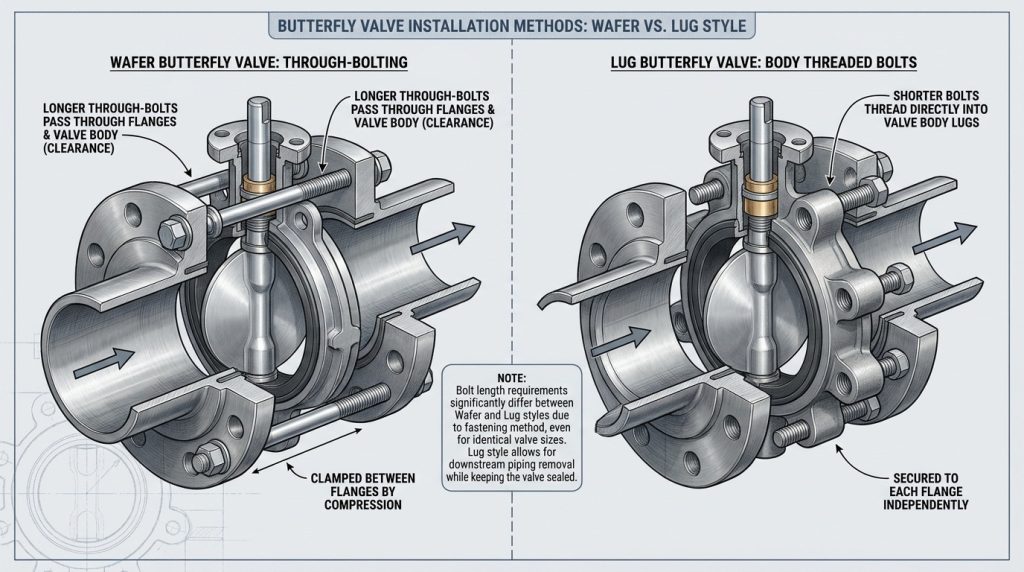
The standard 6 butterfly valve bolt size for an ASME Class 150 system is 3/4 inches in diameter with a thread pitch of 10 threads per inch (TPI). This standardized sizing allows engineers and maintenance teams to source replacement fasteners quickly during routine maintenance. The standard length will shift depending on whether your system uses wafer or lug valves. You must carefully verify these specifications to avoid installation errors.
How do wafer and lug sizes compare?
While both valve types share the same bolt diameter, their installation methods demand completely different lengths. Here is the deal: wafer bodies require long bolts to span the whole assembly, while lug bodies use shorter bolts that screw directly into the body.
- Wafer bolts must pass through both flanges and the valve.
- Lug bolts thread directly into the valve’s threaded ears.
- Both styles rely on the same 3/4-inch diameter standard.
Keeping these differences in mind prevents you from ordering the wrong hardware lengths.
| Valve Type | Bolt Diameter | Length | Thread Count |
|---|---|---|---|
| Wafer Style | 3/4″ | 5-1/2″ | 10 TPI |
| Lug Style | 3/4″ | 2″ | 10 TPI |
This data highlights how the valve’s physical construction directly dictates the required fastener length.
Key Takeaway: Always cross-reference your valve body style with standard charts to select the right length.
Which standard governs 6 butterfly valve bolt size?
The global standards governing the 6 butterfly valve bolt size are primarily ASME B16.5 for imperial systems and EN 1092-1 for metric systems. These regulatory standards ensure that valves and flanges from different manufacturers fit together seamlessly. They define critical dimensions like the bolt circle diameter and the exact number of holes required. Adhering to these standards is essential for maintaining the pressure rating of your system.
Why are international standards vital?
Using components designed to international standards guarantees compatibility across different suppliers. Let’s face it: trying to force a metric bolt into an imperial flange is a recipe for immediate disaster.
- Ensures consistent bolt circle diameters.
- Guarantees proper alignment during assembly.
- Maintains the certified pressure boundary.
You can easily avoid compliance issues by sticking to these recognized international guidelines.
| Standard | Pressure Rating | Bolt Hole Qty | Thread Type |
|---|---|---|---|
| ASME B16.5 | Class 150 | 8 | Imperial (UNC) |
| EN 1092-1 | PN16 | 8 | Metric (Coarse) |
Comparing these standards helps you select the correct thread types for your specific regional project.
Key Takeaway: Operating within established international standards eliminates compatibility issues during piping installation.
How to measure 6 butterfly valve bolt size?
You can accurately measure the 6 butterfly valve bolt size by using a vernier caliper for the shank diameter and a thread pitch gauge for the threads per inch. Taking these physical measurements on-site removes any guesswork and prevents the installation of incorrect fasteners. You should always measure the bolt length starting from directly under the hex head to the very end of the shank. This guarantees that your calculated lengths match the standard dimensions required.
What is the best way to measure?
Using the proper tools is the key to obtaining highly accurate physical measurements. Here is the deal: eye-balling a thread or relying on a standard tape measure often leads to errors.
- Use calipers to measure the outer diameter.
- Count the threads or use a pitch gauge.
- Measure the overall length of the bolt shank.
Taking these precise steps ensures you will always purchase compatible hardware for your piping.
| Measurement | Tool Used | Target Metric |
|---|---|---|
| Shank Diameter | Caliper | Inches or Millimeters |
| Thread Pitch | Pitch Gauge | TPI or Millimeter Pitch |
| Length | Ruler | Inches (under head to tip) |
This simple measurement process provides a foolproof way to verify your hardware before installation begins.
Key Takeaway: Utilizing precise measuring tools is the most reliable way to avoid ordering incorrect fastener sizes.
Where is a 6 butterfly valve bolt size applied?
The 6 butterfly valve bolt size is applied in massive industrial flow networks, including municipal water distribution, HVAC cooling loops, and chemical processing lines. These heavy-duty applications rely on six-inch pipelines to transport high volumes of liquid or gas efficiently. Ensuring these joints are secured with the correct fasteners is critical for preventing costly system downtime. You will find these valves in almost any modern commercial or industrial facility.
What are the main applications?
Different industrial applications place varying physical demands on your valve assemblies. Think about it: a chemical processing plant requires vastly different hardware durability than a simple commercial HVAC setup.
- Municipal water systems require reliable, rust-resistant fasteners.
- HVAC systems require tight seals to handle temperature fluctuations.
- Chemical plants require corrosion-resistant alloys like stainless steel.
Choosing the right material for your specific environment ensures long-term operational success.
| Application | Typical Medium | Pressure Class |
|---|---|---|
| Water Treatment | Wastewater / Slurry | PN10 / PN16 |
| HVAC Systems | Chilled Water | Class 150 |
| Chemical Plants | Acidic Solutions | High Corrosion |
This application matrix outlines where and how these robust valve connections are utilized.
Key Takeaway: Matching your bolt material to the specific environment prevents accelerated wear and sudden joint failure.
Can pressure alter 6 butterfly valve bolt size?
While system pressure does not alter the nominal 6 butterfly valve bolt size, it heavily dictates the necessary bolt material grade and the overall number of fasteners required. Higher pressure classes, like Class 300, require high-tensile alloy steels to withstand the immense axial force exerted on the flange joint. Failing to upgrade your material grade in a high-pressure environment can lead to immediate bolt stretching. You must always align your fastener strength with your pipeline’s maximum pressure rating.
How do pressure classes affect hardware?
When moving to higher pressure classes, you will notice immediate changes in both the bolt count and material requirements. Let’s dive in:
- Class 150 systems require fewer, standard carbon steel bolts.
- Class 300 systems demand high-strength alloy steels.
- Higher pressure requires more bolts to distribute the load.
Understanding these changes prevents you from installing weak hardware in extreme environments.
| Pressure Rating | Bolt Diameter | Bolt Qty | Material Grade |
|---|---|---|---|
| Class 150 | 3/4″ | 8 | Grade 8.8 / B7 |
| Class 300 | 3/4″ | 12 | ASTM A193 B7 |
This data table illustrates how rising pressure requirements dictate tougher hardware specifications.
Key Takeaway: High-pressure applications require premium alloy steel fasteners to avoid catastrophic joint failure.
How many bolts are in a 6 butterfly valve bolt size?
A standard 6 butterfly valve bolt size requires exactly 8 bolts for a wafer-style installation and 16 bolts for a lug-style installation. This difference is due to the mechanical design of the valves, where wafer styles sandwich between flanges and lugs secure each side independently. Knowing this quantity beforehand ensures you purchase the exact amount of hardware needed. You must never attempt to skip bolts during installation, as this ruins the seal.
Why does bolt count vary by valve style?
The design of your valve body dictates how it secures to the surrounding pipe system. Here is the deal: wafer style relies on long bolts going all the way through, while lug style relies on shorter bolts threading into the body.
- Wafer style uses 8 long bolts to hold the assembly together.
- Lug style uses 16 short bolts for independent side-by-side connection.
- Double-flanged valves typically require 16 studs.
Ensuring you have the correct bolt count prevents dangerous system leaks during startup.
| Valve Body Style | Bolts Required | Nuts Required | Bolt Type |
|---|---|---|---|
| Wafer | 8 | 8 / 16 | Hex/Stud Bolt |
| Lug | 16 | 0 (threads into body) | Hex Bolt |
This breakdown simplifies your inventory management by detailing the hardware needed for each configuration.
Key Takeaway: Double-check your valve body style to purchase the correct number of fasteners.
Does torque affect 6 butterfly valve bolt size?
While torque does not alter the physical 6 butterfly valve bolt size, it directly dictates the bolt’s tensile performance and the overall integrity of the flange seal. Applying the correct torque ensures that the gaskets are compressed evenly without damaging the valve seat. If you over-torque the bolts, you risk warping the valve or stripping the threads. Correct tightening sequences are critical to the success of your installation.
What are the risks of incorrect torque?
Tightening bolts requires a methodical, incremental approach to prevent uneven pressure across the sealing surface. Think about it: unevenly tightened bolts will warp your valve body, creating immediate leak pathways.
- Excessive torque stretches the bolt past its yield point.
- Insufficient torque allows the joint to leak under pressure.
- Uneven torque damages the sensitive rubber valve seat.
You must always utilize a calibrated torque wrench and follow standard cross-patterns.
| Tightening Stage | Target Torque % | Pattern |
|---|---|---|
| Stage 1 | 30% | Cross-Pattern |
| Stage 2 | 60% | Cross-Pattern |
| Stage 3 | 100% | Cross-Pattern |
This torque matrix outlines how to safely apply tension to your valve hardware.
Key Takeaway: Following a multi-stage torque sequence prevents gasket damage and ensures a leak-free seal.
Is 6 butterfly valve bolt size different for lugs?
The nominal 6 butterfly valve bolt size for lug bodies is identical in diameter and thread pitch to wafer styles, but it requires much shorter bolt lengths. This length variance exists because lug valves use short bolts that thread directly into the valve’s threaded ears from either side. Wafer styles, on the other hand, require long studs that pass through the entire valve width. You must purchase the correct lengths to avoid mechanical interference during assembly.
How do you contrast the physical differences?
Understanding how these two physical body styles differ prevents costly errors during system installation. Let’s dive in:
- Wafer style uses long through-bolts to sandwich the valve.
- Lug style uses short bolts that do not pass through.
- Lug style allows you to perform downstream pipe maintenance safely.
Choosing the right bolt style keeps your piping system secure and easy to maintain.
| Attribute | Wafer Valve Hardware | Lug Valve Hardware |
|---|---|---|
| Bolt Length | 5-1/2″ | 2″ |
| Thread engagement | Through-flange only | Directly into valve body |
| Installation Style | Sandwich style | Threaded flange connection |
This direct comparison table highlights the unique physical traits of wafer versus lug hardware.
Key Takeaway: Make sure to select shorter bolts for lug-style bodies to prevent bottoming out.
How to Secure Your Industrial Flow Systems?
Selecting the perfect fasteners and executing flawless torque sequences is the only way to safeguard your facility from unexpected downtime and hazardous fluid leaks. This guide has solved your most common installation issues by showing you how to read bolt charts, calculate lengths, and avoid hardware mismatches.
We are dedicated to providing the highest-quality industrial valves and compatible accessories to keep your operations running smoothly. If you are ready to optimize your pipeline systems, contact us today to speak with our application engineers. Let us help you build a safer, more efficient, and highly sustainable flow control infrastructure.
FAQ Section
Can I use metric bolts on an ASME Class 150 flange?
Answer: No, you cannot. ASME Class 150 flanges are engineered strictly for imperial thread profiles (such as 3/4″ – 10 TPI). Attempting to force metric bolts will strip the threads or lead to loose connections.
What’s the best material for highly corrosive environments?
Answer: Stainless steel is the absolute best option. Fasteners made from Grade 316 stainless steel or Teflon-coated steel offer superior resistance to rust and chemical attack, ensuring long-term structural integrity.
How do I know if my bolts are over-tightened?
Answer: You can check for physical deformation on the fasteners. If you notice structural distortion in the gaskets, bolt elongation, or thread damage, the hardware has exceeded its elastic limits.
Can I reuse old bolts for a new valve installation?
Answer: No, it is not recommended. Used bolts often suffer from thread fatigue, rust, or permanent elongation from prior torquing, which prevents them from holding pressure reliably.
How do I know if a wafer valve is centered properly?
Answer: You can verify alignment visually by inspecting the flange gap. If the valve body is perfectly concentric with the flange faces, the internal disc will not strike the pipe inner wall.